1. How to Choose Custom Apparel: A Head-to-Head Specification Comparison
The core decision in custom apparel procurement is not which decoration method looks better — it's which fabric construction can support that decoration through the intended use cycle. A 500-unit corporate order with embroidered logos failed within 14 weeks because the open-end yarn twist variance in the budget-grade polo shirts caused the embroidery to pucker and distort after the third commercial wash. The thread tension requirements for clean embroidery (minimum 7 stitches/mm stitch density count) exceeded the fabric's structural stability. The buyer saved $2.10 per unit on the blank and spent $6.80 per unit replacing the entire order within the fiscal year.
The selection matrix starts with three variables: substrate chemistry, decoration method, and end-use environment. Cotton-rich fabrics (≥80% cotton) accept screen-printed plastisol ink with proper adhesion at 320°F cure temperatures. Performance polyester substrates require DTF transfers with polymer adhesion chemistry capable of maintaining peel strength above 2.5 lb/in through 50+ wash cycles. Between these extremes lies a spectrum of cotton-poly blends, each with specific decoration compatibility and shrinkage profiles. Ring-spun yarn construction delivers smoother print surfaces and 30-40% higher tensile strength than open-end equivalents, but adds $0.85-1.50 per unit to blank cost. Open-end yarn produces bulkier fabric with higher twist variance — acceptable for promotional giveaways, but unsuitable for fine-detail screen printing below 0.5mm line width.
The most expensive mistake procurement teams make is selecting decoration method before substrate. Screen print chemistry fails on polyester. DTF adhesion delaminates on high-spandex blends. Sublimation requires 100% polyester for dye penetration. The decision sequence must be: use-case → fabric → decoration. Every other ordering sequence generates 20-40% downstream failure rate.
📍 Related Sourcing Inventory / custom-t-shirts
2. Side-by-Side: Cotton GSM ranges Benchmark Table
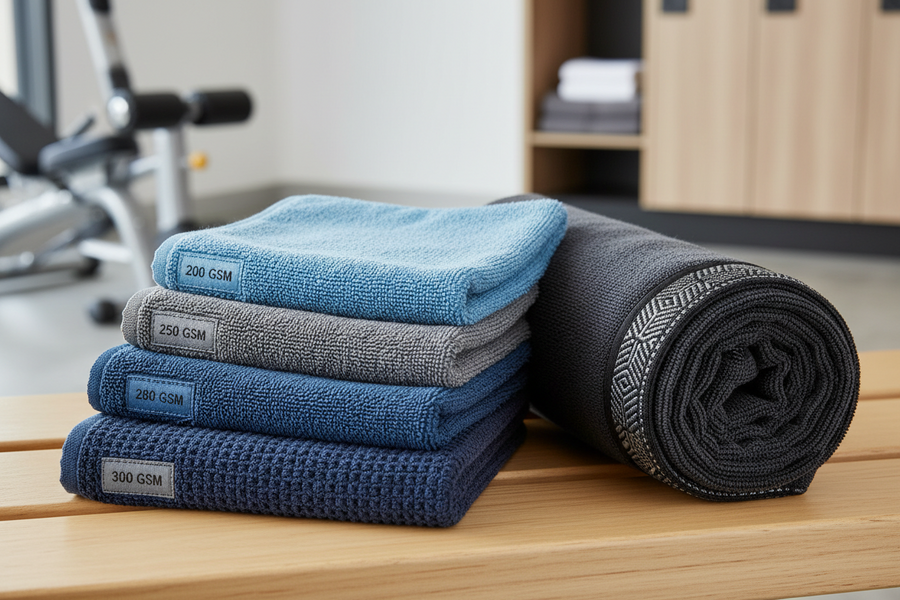
GSM (grams per square meter) is the single most useful specification for comparing custom apparel blanks. The conversion from ounces per square yard: divide GSM by 33.9. Most corporate programs operate within the 130-190 GSM range. Below 130 GSM, garments lack structure for screen printing and show visible under-base bleed. Above 190 GSM, fabric weight adds cost and reduces breathability — appropriate for outdoor workwear, not indoor corporate programs. Pre-shrink treatment tolerance must be specified at 2% maximum across all dimensions; higher tolerance indicates inadequate finishing.
Cotton Fabric GSM Benchmark: Weight, Construction & End-Use Suitability
| GSM Range |
oz./yd² (approx) |
Yarn Construction |
Shrinkage Tolerance |
Best Use Case |
| 130-150 GSM |
3.8-4.4 oz |
Ring-spun, combed cotton |
≤2% (pre-shrunk) |
Corporate indoor, client gifting, retail-quality apparel |
| 160-180 GSM |
4.7-5.3 oz |
Ring-spun or open-end; 50/50 cotton-poly blend |
≤3% (enzyme-washed) |
Employee uniforms, all-season wear, trade show staff |
| 190+ GSM |
5.6+ oz |
Open-end or ring-spun heavyweight |
≤3% (preshrunk) |
Outdoor workwear, field crews, high-durability programs |
Ring-spun construction in the 130-150 GSM tier (e.g., Bella+Canvas 3001 at 4.2 oz/142 GSM) produces the smoothest print surface and highest embroidery stitch definition. Open-end yarn in the 190+ GSM tier (e.g., Gildan 4100 at 5.3 oz/180 GSM) offers cost-effective durability for high-volume giveaways but shows ink bleeding on fine details. The 50/50 cotton-poly mid-range (160-180 GSM) delivers balanced shrink resistance and decoration versatility — screen print, DTF, and embroidery all perform adequately on this substrate. Specify GSM tolerance at ±5% of spec; variance beyond this indicates inconsistent manufacturing lot quality. Independent lab verification of GSM weight and yarn twist should be conducted on pre-production samples for orders exceeding 500 units.
3. Where Screen Print Changes the Calculation
Screen print dominates the custom apparel market because the math works at scale. A 2-color, 1-location screen print on 200 cotton t-shirts costs $1.80-2.50 per unit including ink and setup amortization. The same design via DTF runs $3.50-5.00 per unit at equivalent quantity. The gap narrows at 50 units ($3.20-4.10 for screen print, $4.50-6.00 for DTF) and reverses at 24 units (screen print setup cost dominates). Screen print ink chemistry requires cotton content ≥80% for proper adhesion. On 50/50 cotton-poly blends, plastisol ink still performs adequately with proper curing, but on 100% polyester, adhesion drops below 1.5 lb/in peel strength — visible cracking appears by cycle 10-15.
The curing process is the critical control point. Plastisol ink must reach 320°F internal temperature on the conveyor dryer for 45-60 seconds to achieve cross-linking. Under-cured ink fails crocking tests (wet/dry friction scale, ISO 105-X12) at Grade 2-3, meaning the decoration transfers to adjacent surfaces on contact. Over-curing above 340°F causes ink stiffening and reduced flexibility — cracking appears along crease lines. Commercial laundering programs (ISO 105-C06 at 60°C) separate properly cured prints (Grade 4-5 after 50 cycles) from under-cured failures (Grade 2-3 by cycle 10). Specify curing parameters in the production spec and require crocking test results on sample submissions.
For designs with five or more colors or gradient artwork, screen printing becomes cost-prohibitive because each color requires a separate screen ($20-35 per screen, minimum 6 screens). DTF or sublimation deliver lower total cost at comparable quality. Screen print's primary advantage is color matching accuracy — Pantone matching system (PMS) color calibration achieves ΔE < 1.5 on cotton substrates. DTF color matching varies by transfer film and heat press parameters, typically ΔE 2.0-3.0. If brand color fidelity is non-negotiable, screen print on cotton-rich fabric remains the standard.
4. Procurement Math: Landed Cost Across Volume Tiers
The per-unit cost calculation for custom apparel is a function of four variables: blank cost, decoration cost, setup amortization, and freight. A 130 GSM ring-spun cotton t-shirt blank costs $4.20-5.80 at 100-unit volume. A 2-color screen print adds $1.80-2.50 at 100 units. Setup ($45-65 per screen) amortizes to $0.90-1.30 per unit at 100, dropping to $0.45-0.65 at 200. Freight adds $0.60-1.20 per unit depending on weight and zone. Landed cost at 100 units: $7.50-10.80. At 500 units: $5.90-8.20 — a 22-24% reduction.
Decoration method shifts the volume curve. Screen print setup costs require ≥24 units for viable amortization; at 12 units, setup dominates at $3.75-5.40 per unit. DTF has minimal setup ($20-30 film charge) but higher per-unit transfer cost ($3.50-5.00 at 100). The crossover point is approximately 75 units for 2-color designs — above 75, screen print wins on cost; below 75, DTF's lower setup justifies the higher per-unit transfer cost. Embroidery pricing depends on stitch count: a 7,000-stitch logo costs $4.50-6.50 per location at 100 units, dropping to $3.20-4.80 at 500. Stitch density count above 9 stitches/mm increases thread cost and production time without visible improvement; below 6 stitches/mm loses definition.
Freight optimization requires attention to weight breaks. A 500-unit order of 160 GSM polos weighs approximately 215-240 lbs. FedEx Ground commercial rates: $1.15-1.45 per lb for 200-500 lb shipments. Palletized LTL freight for orders exceeding 1,000 units reduces per-unit freight by 35-50% but adds 2-3 days transit. Build total landed cost projections at 3 volume tiers before selecting MOQ — the optimal economic order quantity often falls at the weight break threshold, not the decoration price break.
📍 Related Sourcing Inventory / custom-hoodies-sweatshirts
5. Three Failure Modes Procurement Teams Don't See Coming
Failure Mode 1: Shrinkage Variance Between Fabric Blends. A corporate program orders 300 units across 4 SKUs: 100% cotton t-shirts (180 GSM), 50/50 cotton-poly hoodies, and polyester performance polos. The t-shirts shrink 3-4% in the first industrial wash, the hoodies shrink 2-3%, the polos shrink 0.5%. The decoration alignment on screen-printed t-shirts shifts 0.75 inches up the garment after the first wash batch. The replacement cost: $6.20 per unit × 300 units × 40% failure rate = $744. Pre-production wash testing at 3 sample garments per SKU identifies variance before bulk commitment. Specify shrink tolerance at ≤2% across all substrates for multi-SKU programs.
Failure Mode 2: Decoration Adhesion Incompatibility. A 500-unit order of 100% polyester moisture-wicking tees with moisture-wicking capillary rate of 12 cm/30min receives screen-printed logos. The plastisol ink fails to bond with the hydrophobic fiber surface. Peel strength measures 0.8 lb/in at 72 hours post-cure. Within 3 commercial wash cycles (ISO 105-C06, 60°C), 40% of the decorations show visible cracking and delamination. The supplier's decoration method specification did not include substrate chemistry — the buyer relied on the supplier's default recommendation. Financial impact: $4,750 replacement cost + $1,200 expedited freight. Mitigation: require supplier to verify decoration-to-substrate compatibility via test print on production substrate before bulk order. Request peel strength test results (minimum 2.5 lb/in for DTF, 3.0 lb/in for screen print on cotton).
Failure Mode 3: Colorfastness Degradation. A uniform program specifications document did not include ISO colorfastness thresholds. Dark navy polo shirts with embroidered logos fade to medium blue by cycle 18 of the commercial laundry program. The ISO 105-B02 lightfastness rating (tested after the fact) measured Grade 3, below the Grade 4 minimum required for corporate programs. The procurement team had approved the supplier's standard product without requiring certification. Results: 200 employee uniforms visibly inconsistent across the cohort within 5 months. The replacement cost: $3,200 + program manager time to re-source and re-approve. Action: specify ISO 105-C06 wash fastness at Grade 4 minimum and ISO 105-B02 lightfastness at Grade 4 minimum in all apparel procurement spec sheets. Require lab test certification from an accredited third-party facility for orders exceeding 200 units.
6. Compliance Checkpoints Before You Sign the PO
Three documentation requirements should be satisfied before purchase order release for custom apparel orders exceeding 50 units.
Checkpoint 1: Fabric Composition and Weight Certification. Request the supplier's mill test certificate specifying GSM weight, yarn construction (ring-spun vs open-end), and blend ratio. Acceptable tolerance: ±5% GSM, ±3% blend ratio. For cotton blends, require OEKO-TEX Standard 100 certification (Class II for direct skin contact) or bluesign approved dye facility verification. Without certification, the supplier may substitute lower-grade fabric without disclosure — the finished garment's print surface and shrink profile will differ from samples.
Checkpoint 2: Decoration Method Protocol. For screen print: require curing temperature verification (minimum 320°F internal substrate temperature) and conveyor dryer belt speed confirmation. For DTF: require transfer temperature (320-340°F), pressure (50-60 PSI), and dwell time (8-12 seconds) specifications. For embroidery: require stitch density count (minimum 7 stitches/mm) and thread tension settings. Request a physical sample with the production protocol documentation — the sample serves as the acceptance standard for the bulk order.
Checkpoint 3: Colorfastness and Durability Test Results. For corporate uniform programs expected to exceed 26 wash cycles annually, require ISO 105-C06 wash fastness test results at Grade 4 minimum for color change and staining. Require ISO 105-X12 crocking (wet/dry friction) at Grade 4 minimum. For outdoor or high-exposure garments, require ISO 105-B02 lightfastness at Grade 4 minimum (100 hours xenon arc exposure). The test report must identify the specific laboratory conducting the test and include the date of testing. Re-testing at the buyer's expense may be required for orders exceeding 500 units.
7. Procurement FAQ
Q: What is the practical difference between ring-spun and open-end cotton yarn construction for custom apparel?
Ring-spun yarn twists fibers continuously in a single direction, producing smoother, stronger yarn with 30-40% higher tensile strength and reduced twist variance compared to open-end. Open-end yarn uses centrifugal force to spin fibers, creating a bulkier texture with higher twist variance and lower tensile strength — acceptable for budget promotional apparel but unsuitable for fine-detail screen printing or dense embroidery. Ring-spun fabric yields sharper print edge definition below 0.5mm line width; open-end may show ink bleeding and fiber pilling after 10-15 wash cycles. For corporate uniform programs, ring-spun adds $0.85-1.50 per unit to blank cost but extends garment life by 40-60%.
Q: How do I choose between screen printing and DTF for a 200-unit custom t-shirt order?
Screen printing delivers the lowest per-unit cost at 200 units ($1.50-2.50 for 2-color/1-location) but requires color count limitations — each color adds $0.35-0.70 per unit and $45-65 in setup cost. DTF runs $3.50-5.00 per unit at 200 units with unlimited colors and zero setup per color, making it cost-competitive for designs with 5+ colors or gradients. Screen print achieves 50+ wash durability on cotton-rich substrates (≥80% cotton); DTF maintains peel strength above 2.5 lb/in on polyester and cotton blends. For 100% polyester performance fabric, DTF is the mandatory choice — screen print adhesion fails on hydrophobic fibers.
Q: What MOQ and lead time should I expect for a custom polo shirt program with embroidery?
Embroidery requires minimum 24 units for cost-effective setup amortization — setup fees ($45-65 per location) add $1.90-2.70 per unit at 24 units, dropping to $0.45-0.65 at 100 units. Lead time averages 10-14 business days from art approval, with sample embroidery (1-3 garments) requiring 3-5 days for approval before bulk production. Stitch density count between 7-9 stitches/mm achieves crisp logo reproduction; below 6 stitches/mm loses definition on lettering and fine details; above 10 stitches/mm increases production time 15-20% without visual improvement. Specify stitch count on the PO to avoid unapproved density variation.
Q: How do I verify colorfastness compliance for corporate uniform programs requiring commercial laundering?
Request ISO 105-C06 wash test certification and ISO 105-B02 lightfastness results from an accredited third-party laboratory. Minimum acceptable for corporate programs: Grade 4 on the 1-5 gray scale for both color change and staining on adjacent fabric (ISO 105-C06). For lightfastness: Grade 4 minimum after 100 hours xenon arc exposure (ISO 105-B02). For crocking (wet/dry friction): Grade 4 minimum (ISO 105-X12). Without these specifications, dark colors fade visibly by cycle 15-20, creating inconsistent uniform appearance across employee cohorts. Replacement cost for a 200-unit program with colorfastness failure: $3,200-4,000 + re-sourcing timeline. Require lab test documentation on each production lot for orders exceeding 200 units.