Best Custom Products for Trade Shows (That Actually Get Used)
The booth is booked. The team is ready. The giveaways? A pile of cheap pens that will be forgotten by lunch. The assumption that a bigger order always means a better price only holds up about half the time.
Choosing the right trade show products is about more than unit cost—it's about landed cost, lead time, and what actually gets used. This guide covers the best custom products for trade shows and the logistics that make them work.
The Real Question: What Actually Gets Used?
The surface question is "what should we give away." The real question is "what will our audience actually keep and use." A product that ends up in a drawer or the trash has a cost per impression of zero. A product that is used regularly keeps your brand top of mind.
We've seen this pattern enough times to know it's not a one-off. A team ordering 500 custom pens for a trade show might think they are making a smart investment. But pens are often lost or discarded. A tote bag that is reused for groceries, or a t-shirt that is worn, provides ongoing brand exposure long after the event.
This is where most buyers slow down. The decision is not just about cost per unit. It is about cost per use. A product that is used 100 times costs less per impression than a product that is used once.
The real driver here is not the product itself—it's the alignment between the product and the recipient's daily life. A useful product stays. A novel product gets tossed.
The Top Contenders: What Works Best
Based on utility, cost, and logistics, these products consistently perform well for trade shows.
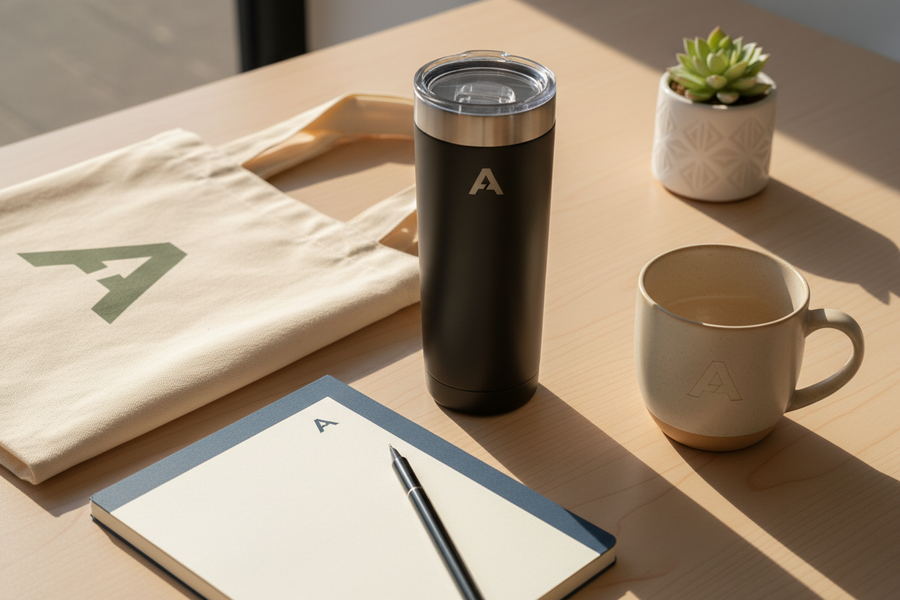
Tote bags (10oz canvas) are a top choice. They are durable, reusable, and offer a large branding area. The 10oz canvas material feels premium and holds up to daily use. They pack flat, making them easy to ship and store. Screen printing is cost-effective for bulk orders. A tote bag is a walking billboard that keeps your brand visible long after the event.
T-shirts are the classic choice. They offer a large branding area and are highly visible. Screen printing is cost-effective for bulk orders (100+ units), and the per-unit cost drops with volume. T-shirts are easy to distribute and ship flat. The trade-off: sizes complicate inventory, and you need to account for size distribution.
Notebooks have high utility in professional settings. They are flat and easy to ship. Offset printing setup is moderate, but the per-unit cost is low. A custom notebook is a gift that stays on a desk for weeks or months, keeping your brand in front of the recipient.
Power banks have high perceived value and are used frequently. However, they are more expensive than other items and require battery safety compliance (UN38.3). They are best for premium giveaways or high-value attendees.
Pens are a high-volume, low-cost option. They are easy to distribute and ship. The utility is low, but the distribution is high. Use pens as a secondary item, not the hero.
- Tote bags (10oz canvas): Durable, reusable, large branding area, flat pack.
- T-shirts: Wearable, cost-effective at scale, high visibility.
- Notebooks: Useful, professional, flat shipment.
- Power banks: High cost, battery compliance, heavier shipping.
- Pens: Low utility, low perceived value, easily lost.
- Mugs: Fragile, complex packaging, moderate setup cost.
Logistics: The Unseen Factor
A trade show giveaway is not just a marketing item—it's a physical good that needs to be shipped, stored, and distributed. Logistics planning is often overlooked until it becomes a bottleneck.
Multi-factory coordination is a common challenge. If you are ordering t-shirts from one supplier, tote bags from another, and notebooks from a third, you need to align their delivery dates. A t-shirt takes one week. A tote bag takes two. A notebook takes three. If you order everything at the same time, the notebooks will delay the entire event. The solution: map lead times for each category and start the longest lead-time item first.
Freight consolidation is another consideration. Shipping from multiple factories to a single venue adds complexity and cost. A freight forwarder can consolidate shipments at a hub and deliver them as a single shipment. This reduces freight costs and simplifies receiving at the venue.
Venue receiving compliance is a practical constraint. Many venues have specific receiving hours, dock requirements, and advance notice periods. Check the venue's receiving policy early and plan your shipment accordingly. A missed delivery window can result in storage fees or a delayed booth setup.
It's common for two suppliers to describe the "same" material using completely different testing methods. One might quote a 10oz canvas using one weight standard, while another uses a different standard. The actual fabric weight may be the same, but the numbers are different. Ask for a sample to verify the material before bulk.
Trade Show Logistics Checklist
- Map production lead times for each item and order sequentially.
- Add a 15% quantity buffer to cover attrition and last-minute demand.
- Use a freight forwarder to consolidate multi-factory shipments.
- Confirm the venue's receiving policy and shipping deadlines.
- Plan storage and distribution workflow for the booth.
- Build in a 1-2 week buffer for shipping and customs.
Decision Framework: Landed Cost and Hidden Fees
The decision framework should be anchored in landed cost, hidden fees, and long-run value rather than sticker price alone. A product that looks cheap per unit may be expensive once shipping, duties, and assembly are factored in.
Calculate per-booth kit cost. If you are assembling kits (e.g., a tote bag with a notebook and a pen), calculate the total cost per kit. Include the unit price, setup fees, shipping, duties, and any kitting assembly fees. This is the true cost of the giveaway.
Factor in freight. Freight is often quoted separately. If you are shipping from multiple factories, consolidation freight fees apply. A freight forwarder can provide a single quote for the entire shipment. Compare this to shipping each item separately.
Account for duties and taxes. If you are importing, duties and taxes can add 5-20% to the total cost. Factor this into your budget. A supplier that quotes an "all-in" price may not include duties. Ask for the Incoterms (e.g., EXW, FOB, DDP) to understand who pays for shipping and duties.
Consider the cost of rework. A product that fails quality control will need to be reordered. The cost of rework (setup fees, shipping, lead time) is higher than the cost of a higher-quality initial product. A slightly higher upfront cost is often a better value than a lower upfront cost with a higher risk of rework.
Interestingly, most buyers who have done this before don't start with price — they start with communication speed and sample accuracy. A supplier that is responsive and transparent during the quoting phase will save you time and stress during production.
A pattern that shows up again and again: teams that skip a pre-production sample almost always regret it by the second batch. A sample ensures the product meets your quality and color standards. It also gives you a chance to test the packaging and shipping weight. The sample is a small investment that protects a larger one.
Artwork Cutoff: The Deadline That Matters
Artwork approval is a milestone that is often underestimated. A design that looks final on a screen may need adjustments for the substrate or decoration method.
Set your artwork cutoff at least 5 business days before production start. This allows time for revisions and approvals without delaying production. A last-minute revision can push the entire timeline by a week.
Include these elements in your artwork brief:
- Pantone PMS references for each color.
- Vector file format (.ai, .eps, .svg).
- Minimum detail size (e.g., text line weight).
- Printable area dimensions (if applicable).
We've seen a startup's first office move needing everything sourced at once. The design team approved the artwork late, and the production run was delayed by 10 days. The event date didn't move. The team had to pay expedite fees to catch up. The lesson: artwork deadline is a non-negotiable milestone.
What Buyers Usually Ask Next
What is the most popular trade show giveaway product? Tote bags and t-shirts consistently top the list because they offer large branding areas and high utility. Tote bags are reusable, and t-shirts are wearable. Both provide ongoing brand exposure long after the event. Their cost per impression is among the lowest.
What is the most cost-effective giveaway for a trade show? A 10oz cotton canvas tote bag with a one-color screen print balances cost and perceived value. It's durable enough to be reused, and the canvas material feels premium. The cost per impression is low because the bag is used repeatedly.
How do I decide between different giveaway items for a trade show? Match the item to the attendee profile. Corporate attendees appreciate useful items like power banks and notebooks. General audiences prefer items like tote bags and t-shirts. Also consider logistics—flat items (totes, t-shirts) are easier to ship and store than bulky items (mugs).
How do I ensure my brand colors match across different suppliers? Assign a single Pantone PMS reference for each brand color and communicate it to every supplier. For items with different substrates (e.g., cotton vs. ceramic), request a physical color card or sample to verify the color before bulk production. This is the most reliable way to maintain brand consistency.