How to Budget for Your First Custom Product Order?
Most 500-unit apparel orders don't actually ship as one batch—they ship as two, three weeks apart, and almost nobody plans for that. The quote says "15 business days." The reality is that 300 units land on week three and the remaining 200 trickle in on week five, after the event they were meant for has passed.
That's not a horror story. That's a standard production pattern that any experienced sourcing team accounts for in their budget and timeline. The question isn't whether your first custom product order will have surprises. The question is which surprises you've already priced in.
The real question behind the title
When a buying team asks "how do I budget for this order," what they're really asking is "how do I avoid looking like I didn't know what I was doing when the final invoice arrives." The surface question is about numbers. The underlying question is about control—knowing what levers exist, which ones matter, and which ones can blindside you.
Something we've seen play out more than once: the internal approval process takes longer than the production itself. By the time the PO is signed, the lead time that was "comfortable" during vendor selection is now "tight" and the freight option you budgeted for is no longer available. The budget didn't change. The timeline did. And the two are always connected.
The failure point on a 300-unit hoodie order is almost never the fabric—it's the embroidery digitizing file. That $75 setup fee per location doesn't include the cost of converting your vector logo into a stitch file that actually works on a fleece substrate. And if you don't catch that early, you're paying for two digitizing rounds instead of one.
What actually costs money—and what doesn't
Let's break this down the way a procurement lead would, not the way a supplier's sales sheet presents it.
Sampling. This is where first-time budgets bleed. Most suppliers charge $100–$300 for a pre-production sample, and that's before shipping. If you need a color correction or a placement adjustment, that's another round—another $100–$300. Industry benchmark: budget for two sampling rounds even if you're confident you'll only need one.【1†L11-L13】 The vendors who waive sampling fees on orders over a certain quantity are usually building that cost into the per-unit price anyway. Nothing is free.
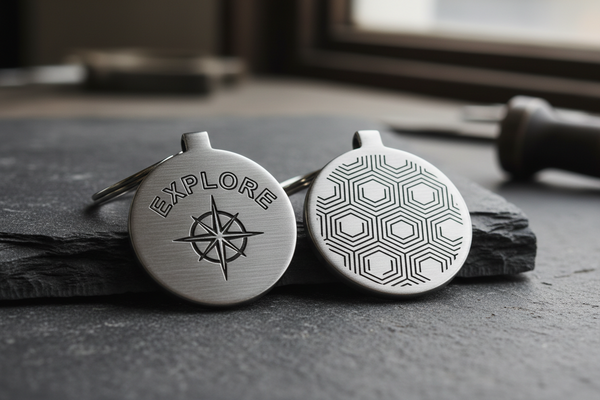
Decoration setup. This is the line item that trips up category comparisons. Screen printing setup runs $50–$150 per color, so a four-color design adds $200–$600 before a single shirt is printed. Embroidery setup is higher—$75–$200 per location—but the per-unit cost drops faster once you hit 100 units.【2†L18-L20】 Laser engraving on stainless steel or ceramic has a different setup profile entirely: higher front-end cost, near-zero per-unit incremental cost after the first 50 pieces.
Per-unit cost. This is the number everyone fixates on, and it's the least informative line on the quote. A $12 shirt with a $200 setup fee costs more at 100 units than a $14 shirt with no setup fee. The break-even point is different for every order. The only way to know which quote is better is to model the total landed cost at your specific quantity.
Freight and customs. The quote says "FOB Shanghai." That means the supplier covers the cost to the port. Everything after that—ocean freight, insurance, customs brokerage, inland freight to your warehouse—is your problem. Standard practice across most sourcing programs: add 15–25% to the FOB price for landed cost, depending on the shipping mode and origin.【3†L20-L23】
Material and product considerations
The substrate you choose changes everything about the budget. Not just the per-unit cost, but the setup, the lead time, and the reorder consistency.
For apparel, the industry benchmark for corporate programs is 180–220 GSM cotton or cotton-poly blends. Below 160 GSM, you're in budget-tier territory—lighter fabric, shorter lifespan, more visible print bleed-through. The difference between 180 GSM and 200 GSM might be $0.50 per unit, but the 200 GSM shirt will hold its shape after 20 washes and the 180 GSM won't. ISO 105-C06 wash-fastness minimum Grade 4 is the documented standard for dye retention; anything below that and your logo starts fading before the program year ends.【5†L10-L12】
For drinkware, the substrate is either ceramic, stainless steel, or plastic, and each one has a different decoration compatibility. Ceramic takes sublimation well but requires a firing cycle that adds 5–7 days to lead time. Stainless steel takes laser engraving beautifully but doesn't hold full-color transfers well. ABS plastic takes pad printing but the ink wears off faster than screen printing on fabric.
A detail that gets missed early on is that MOQ and price-break tiers rarely move in a straight line. The jump from 100 to 250 units might save you $0.80 per unit. The jump from 250 to 500 might save you $0.15. The curve flattens fast. Buying 500 units to get the price break doesn't save money if you only need 300 and the extra 200 sit in a closet for two years.
Process and execution factors
This is where the budget meets reality. The decoration method matrix isn't just about cost—it's about what's actually possible on your chosen substrate, and what the supplier is actually good at.
Screen printing on a 100% cotton t-shirt is straightforward. Screen printing on a polyester performance fabric requires different inks, different curing temperatures, and a supplier who knows the difference. The spec sheet says "screen printing available." The sample that arrives says otherwise. Both suppliers are being honest—they just have different interpretations of what "available" means.
Something that rarely gets discussed openly is how much day-to-day communication quality predicts whether a reorder goes smoothly. The supplier who responds to emails within four hours, sends photos of the sample before shipping, and flags potential issues proactively is the supplier who will catch a color mismatch before it becomes a problem. The supplier who goes silent for three days and then sends an invoice is the supplier who will ship 480 units instead of 500 and call it a "production tolerance."
It usually becomes obvious only after the second reorder that the first vendor was cutting a corner nobody flagged. Maybe the embroidery digitizing was slightly off and the logo looked fine on the first batch but degraded on the second because the stitch density wasn't documented. Maybe the color-matching process wasn't standardized and the second batch came back a shade darker. The budget for the first order didn't account for the cost of switching vendors mid-program.
- Screen printing: Lowest per-unit cost at scale; durable on cotton; setup costs amortize well over 200+ units
- Embroidery: Premium look and feel; excellent durability; works on almost any fabric weight
- Laser engraving: Permanent mark that doesn't fade; no ink or dye to wear off; high-end aesthetic
- Screen printing: High setup cost per color; poor performance on synthetic blends; limited to flat surfaces
- Embroidery: Higher setup cost per location; slower production; thicker thread can distort small text
- Laser engraving: Higher setup cost; limited to compatible substrates; no color options beyond the base material
The decision framework: consistency over the first sample
Here's the framework that separates experienced buyers from first-timers: evaluate every supplier on how consistent their output is across repeat batches, not just how good the first sample looks.
The first sample is a sales tool. The supplier puts their best team on it, uses their best materials, and takes extra time to get it right. The 500-unit production run is a different story. That's when the production manager is juggling five other orders, the ink supplier sent a slightly different batch of white, and the junior press operator is running the overnight shift.
The real issue here is not whether the first batch matches the sample. It's whether the second batch matches the first batch. And the third batch matches the second. If you're planning a program that spans multiple quarters or multiple order cycles, reorder consistency is more important than sample quality.
What actually determines reorder consistency is the supplier's color-matching process. Do they retain a physical Pantone swatch from your first order? Do they document the exact ink formulation or thread color code? Do they run a test print before every production run, or do they assume the settings from last time will still work? The suppliers who can answer these questions with specific procedures are the ones who will deliver the same product in 2027 that they delivered in 2026.
The difference between a supplier who retains Pantone references and one who doesn't is the difference between a reorder that costs $12 per unit and a reorder that costs $12 per unit plus a $400 color-matching charge because they have to start from scratch.
Common pitfalls—observed patterns
These aren't warnings. They're patterns we've seen enough times to recognize.
The "sample is great, production is fine, reorder is wrong" pattern. This happens when the supplier doesn't document the production parameters from the first run. The second run uses a different ink batch, a different curing temperature, or a different thread supplier. The result is close enough that it passes a casual inspection but different enough that it doesn't match the existing inventory.
The "lead time quoted is production time, not delivery time" pattern. The supplier says "15 days." They mean 15 business days from approval of the final sample, not from PO issuance, and not including freight. The actual arrival date is 25–30 days out. The budget didn't account for expedited shipping because the original timeline was "comfortable."
The "setup fee is waived but the per-unit cost is higher" pattern. This isn't deceptive—it's just math. Some suppliers bake setup costs into the per-unit price to make the quote look simpler. The problem is that this model penalizes reorders. If you place a second order for the same design, you're paying the setup fee again in the form of higher per-unit costs, even though no new setup is required.
The "MOQ applies to the blank, not the decorated product" pattern. The supplier might have a 100-unit MOQ for the blank t-shirt, but the screen printing setup requires a 50-unit minimum per color. If you want four colors, you're ordering 200 units minimum, not 100.
Practical signals to look for
When you're comparing quotes or evaluating suppliers, here's what to look for that indicates quality or risk.
Itemized quotes. A supplier who breaks out sampling, setup, per-unit, and freight separately is a supplier who knows their costs and is willing to be transparent. A supplier who gives you a single all-in price is either simplifying for your convenience or hiding margin—and you won't know which until the invoice arrives.
Sample photography. A supplier who sends photos of the sample before shipping—on a mannequin or in natural light—is a supplier who cares about how the product actually looks. A supplier who just ships the sample without previewing it is a supplier who treats sampling as a checkbox, not a quality gate.
Pantone references on the quote. A supplier who lists Pantone color codes on the quote is a supplier who has a color-matching system. A supplier who just says "navy" or "red" is a supplier who will interpret those colors differently on every order.
Lead time buffer conversation. A supplier who asks "when do you actually need this" and then suggests a buffer is a supplier who understands that production delays happen. A supplier who just confirms the lead time and moves on is a supplier who will tell you about the delay after it happens, not before.
- Request two samples from each shortlisted supplier—one for approval, one to keep as a physical reference for reorders
- Ask for setup costs broken out by decoration method, not just a single line item
- Confirm whether the quoted lead time includes freight and customs clearance
- Request the supplier's color-matching process in writing before placing the PO
- Verify the MOQ applies to the finished decorated product, not just the blank substrate
What buyers usually ask next
How much should I budget for sampling on a multi-item program? For a program with three distinct products—say, t-shirts, tumblers, and tote bags—budget $600–$1,200 for sampling across all three, assuming two rounds per item. Some suppliers will credit sampling costs against the bulk order, but don't assume that until it's in writing.
What's the typical lead time difference between apparel and hard goods? Apparel with screen printing typically runs 10–15 business days from sample approval. Custom drinkware with full-color wrap runs 15–20 days. Ceramics with sublimation can push 25 days due to firing schedules. Hard goods generally have longer lead times because of more complex production processes.
How do I verify a supplier's reorder consistency before placing the first order? Ask for references from clients who have placed multiple reorders with the same design. Then call those references and ask specifically about color matching, lead time stability, and whether the second order matched the first. That conversation will tell you more than any spec sheet.
Should I use one vendor for all categories or separate specialists? Separate specialists usually deliver better quality per category, but they add coordination complexity. The tipping point is usually around 3–4 product categories or an annual program value above $50,000. Below that, a single full-service vendor is easier to manage.
Budgeting for your first custom product order isn't about finding the cheapest per-unit price. It's about understanding the full cost landscape—sampling, setup, freight, and reorder consistency—so you can make a decision that holds up across multiple order cycles. The suppliers who are transparent about those costs are the suppliers who will still be delivering consistent product two years from now. The suppliers who hide them are the suppliers who will surprise you when it's too late to change course.