Where to Source Lightweight Recycled Microfiber Towels for a Small Startup

Where to Source Lightweight Recycled Microfiber Towels for a Small Startup

When three high school students in Stockholm started developing a multifunctional towel through their school’s entrepreneurship program, they weren’t looking for a thick bath towel. Their company, Tovéla UF, wanted something closer to the lightweight microfiber towels used for swimming, training, travel, and outdoor activities — around 100 × 150 cm, made from recycled polyester microfiber, quick-drying, absorbent, and soft against the skin. They also wanted it to pack small, roll up neatly, and carry a small logo rather than a large print. The tricky part wasn’t the product idea. It was sourcing it in a quantity that made sense for a new student company: roughly 20–25 towels. That small-order reality shapes almost every decision that follows.
 Home › All SupplyBatch Collections › SupplyBatch Journal
Custom Sports Towels for a Polynesian Racquet Sports Brand: From Material Selection to Small-Batch Production From Brand Idea to First Samples: Building a Custom Fitness Set for a New Wellness Brand Custom Tumblers and Silicone Wristbands: A Real-World Guide to Planning a Recurring Merchandise Program Custom A5 Journals in Ten Colors: A Real Wholesale Sourcing Request Private Label Jewelry Cleaning Kit: What to Check Before You Order Custom Ornate Metal Keychain: A Multi-Color Heirloom-Style Design Request Custom A5 Journals: How to Customize an Existing Journal for a Small-Business Collection Custom A5 Journal Sample Request: Building Two Self-Care Journal Designs for Totes & Things Custom Zinc Alloy Bag Charms: From 3D CAD and Prototype to Small-Batch Production Where to Source Lightweight Recycled Microfiber Towels for a Small Startup Ordering Custom Die-Cut Car Air Fresheners? Start With a Small Test Run How to Order Custom Porcelain Espresso Cups with Logo for Cafés and Coffee Brands How to Source Custom PU + Natural Rubber Yoga Mats for a Small Fitness Brand How to Order Custom Fishing Hats: What to Check Before Making Samples Turning a Corporate Mascot Into a Custom 3D Figurine: What to Consider for a 100–150 Piece Run Custom Magnetic Gift Boxes for Clothing Brands: What to Prepare Before Ordering a Sample Custom Mailer Boxes for a Growing Brand: What to Confirm Before Production Custom Pink Paper Shopping Bags for a Clothing Boutique: From Store Branding to Final Specifications Private Label Perfume in Small Batches: How to Test 20 Fragrances Without Overordering Custom Anti-Burst Exercise Balls: How to Choose Size, Color, Logo Printing & Samples Custom Microfiber Sports Towels: How to Choose GSM, Shape, Binding & Branding for a New Product Custom Die-Cut Car Air Fresheners: A Practical Guide to Shapes, Printing, Fragrance & MOQ Sourcing Custom RPET Microfiber Beach Towels for a Student Startup How to Order Custom Sublimation Performance Hoodies: Fabric, Design, Sampling and Production How to Create a Custom Invitation Box from a Reference Box or Sketch How to Choose a Cost-Effective Custom Reusable Shopping Bag for Retail Stores How to Customize Transparent PET Cake Boxes for Bakery Businesses Custom LED Wristbands for Youth Conferences, Concerts & Events Sourcing Bamboo Toothbrushes for the U.S. Market: FDA Registration, Custom Branding, Samples & MOQ Custom Jewelry Care Kits for Christmas Promotions: A Complete Guide for Jewelry Retailers Custom Bag Sample Approval: Why Material and Printing Tests Matter Before Production Custom Printed Doormats: What to Check Before Ordering a Small or Bulk Run What Really Matters When Ordering Custom Clear PVC Tote Bags for a Luxury Retail Store Custom Microfiber Towel Case Study: Enlarging a Logo, Changing Colors, and Choosing the Right Printing Method How to Source Custom 18 Momme Mulberry Silk Scarves: Size, Printing, Hemming, MOQ & Bulk Pricing Guide Custom Matte Waterproof Stickers for Gift Baskets & Hospitality Branding How to Source Custom Closed-Top Popcorn Boxes?Sourcing Custom Closed-Top Popcorn Boxes: Sizing, Print & Freight Large Custom Non-Woven Bags: Stock Colors vs. Custom Laminated Printing How to Launch a Private Label Perfume Brand in South Africa: OEM/ODM Guide Sourcing Custom Brushed Metal Die-Cast Keychains with Scannable QR Codes How to Produce Custom Full-Color Doormats for Direct Mail Campaigns Custom Retail Merch That Customers Actually Use (Not Throw Away)Custom Products for New Retail & Event Brand Merch Sourcing 100 Custom Products: Realistic MOQs, Bag Selection & Print Limits What to Pack in a Trade Show Tote That Attendees Actually Keep? Why Some Custom Event Logos Get Used Daily While Others Get Tossed Trade Show Merchandise Sourcing: 3-Tier Quality and Cost Breakdown Best Custom Merchandise for Lifestyle Brands and Cafes Creative Products for Brand Awareness Campaigns Sourcing Low-Barrier Product Categories for New Private Label Brands Sourcing Custom Travel Bags, Laptop Duffels & Field Accessories

Where to Source Lightweight Recycled Microfiber Towels for a Small Startup

 Sourcing a Lightweight Recycled Microfiber Towel for a Student Startup

When you are starting a small product business, finding the right supplier is often less straightforward than simply finding a product that looks good in a catalog.

A recent inquiry came from three high school students in Stockholm, Sweden, who are developing their own product through their school’s entrepreneurship program. Their company, Tovéla UF, is working on a multifunctional towel designed around comfort, portability, functionality, and personal privacy.

They are not looking for a traditional thick bath towel. Instead, they want something closer to the lightweight microfiber towels commonly used for swimming, training, travel, and other outdoor activities.

What Tovéla UF Is Looking For

The students are looking for a towel of approximately 100 × 150 cm with a lightweight and compact construction.

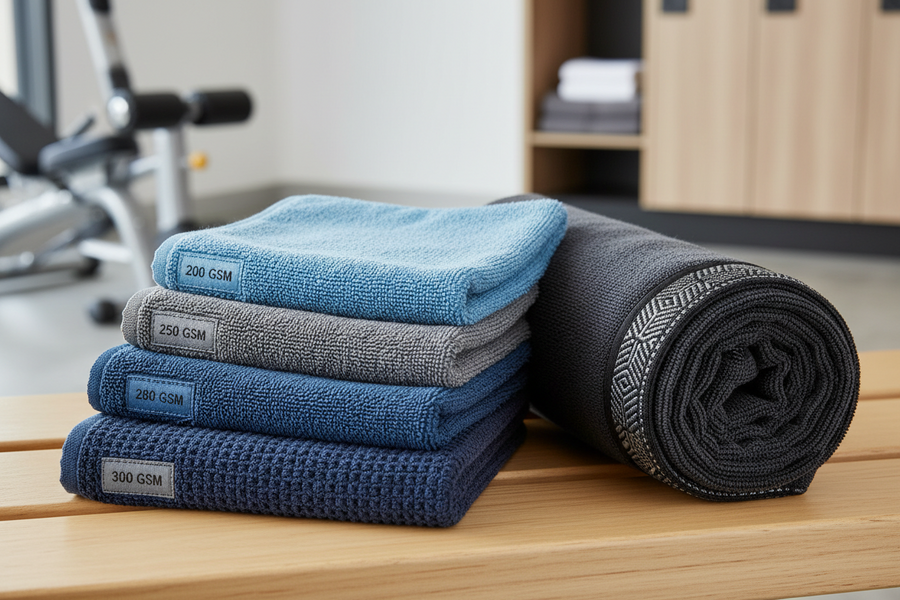
Their preferred material is recycled polyester microfiber (rPET). They are particularly interested in a towel that can dry quickly, absorb moisture effectively, and remain soft and comfortable against the skin.

Because the towel is intended to be carried in a bag, its weight and packed size are also important. The goal is a product that can be easily folded or rolled without taking up much space.

They also have a practical idea for the finished product: a small elastic loop attached to one corner. This would allow the towel to be secured after being rolled up.

For branding, they would like to add a small Tovéla UF logo near the lower-right corner rather than covering the towel with a large print.

Color and Product Development

The students already have a specific color direction in mind and provided a reference image for the shade they would like to use.

For a new business, choosing the exact material and construction is only part of the process. Color consistency, logo placement, printing or embroidery, and the overall feel of the fabric all become important when moving from an existing product to a branded version.

For this reason, they are also interested in receiving a sample before committing to a larger production order.

📍 Related Sourcing Inventory / lightweight microfiber towel

Starting With a Small Quantity

One of the biggest considerations for Tovéla UF is the initial order quantity.

As a newly established student company, they are currently considering an initial order of approximately 20–25 towels.

This is significantly smaller than the quantities normally associated with fully customized textile production. The students therefore asked about both existing towel models and the possibility of customizing an existing product rather than immediately developing a completely new towel.

They also want to understand how the price changes between a small initial order and a larger future production run.

Questions We Would Confirm Before Production

For this type of project, several details need to be confirmed before a supplier can provide a reliable quotation:

  • Exact towel size

  • Microfiber composition

  • Percentage of recycled polyester

  • Fabric weight and thickness

  • Absorbency and drying characteristics

  • Available colors

  • Logo application method

  • Logo size and position

  • Elastic loop construction

  • MOQ for customization

  • Sample availability

  • Sample cost

  • Price for 20–25 pieces

  • Price at larger quantities

  • Production time

  • Shipping cost to Sweden

The recycled-material percentage is particularly important because “recycled polyester” can refer to different material compositions. Confirming the actual fabric composition is therefore more useful than simply describing a towel as an “eco-friendly” product.

Existing Product or Custom Production?

For a small startup like Tovéla UF, an existing lightweight microfiber towel may be a practical starting point.

If a supplier already has a towel close to the requested 100 × 150 cm size, weight, color, and fabric construction, the students may be able to begin with a relatively simple logo customization.

If the existing models do not meet the requirements, a custom version could be considered later as the business develops.

This approach allows a new company to test its product concept without immediately committing to a large production run.

A Small Product With a Clear Use Case

What makes this project interesting is that the students are not simply looking for a generic promotional towel.

📍 Related Sourcing Inventory / recycled polyester microfiber towel

They have already identified how they want people to use the product: as a lightweight towel that can be carried easily, dries quickly, rolls into a compact package, and incorporates a small practical detail such as the elastic loop.

The logo placement is also intentionally modest. Rather than making the branding the main feature, they want the towel itself to remain clean and functional.

For a young company testing a new product concept, these details can be important when evaluating samples.

The Next Step

The most useful next step is to compare a few suitable microfiber towel constructions and determine which one comes closest to the Tovéla UF requirements.

A physical sample can then be evaluated for:

  • Fabric softness

  • Thickness

  • Weight

  • Absorbency

  • Drying speed

  • Packed size

  • Color

  • Logo appearance

  • Overall construction

Once the students have tested the sample, they can make a more informed decision about whether to continue with the existing towel model or develop a more customized version.

For a student startup, starting small and testing the actual product before moving into larger production can make the sourcing process much easier.

Tovéla UF is currently looking for a supplier that can support this initial stage and potentially grow with the product if the concept moves into larger production.

📍 Related Sourcing Inventory / custom logo towel

Start with an existing lightweight microfiber towel close to your target size, then customize with a small logo.

Confirm actual recycled polyester percentage and fabric composition rather than relying on “eco-friendly” labels.

Test a physical sample for softness, thickness, absorbency, drying speed, packed size, color, and logo appearance before ordering.
Provide a reference image for the exact color you want and ask for available color options.

Ask for pricing at both your initial small quantity (20–25) and larger future quantities.

Confirm elastic loop construction and logo position before sampling.
Assuming “recycled polyester” means a specific percentage without asking for composition.

Ordering a fully custom towel before testing whether an existing model already meets requirements.

Treating the logo as the main design feature instead of keeping it small and functional.

❓ Buyer Questions

Q: What size and material should a lightweight travel towel be?
A: Tovéla UF specified approximately 100 × 150 cm in recycled polyester microfiber (rPET). The towel should dry quickly, absorb moisture, stay soft, and pack small. Confirm fabric weight, thickness, and actual recycled percentage rather than assuming “recycled polyester” means one composition.

Q: Should a small startup order an existing towel or a fully custom one?
A: If an existing lightweight microfiber towel is close to your target size, weight, color, and construction, starting with simple logo customization is more practical. A fully custom towel can be considered later if existing models don’t meet requirements. This lets you test the concept without a large production commitment.

Q: What should be confirmed before requesting a quote?
A: Confirm exact towel size, microfiber composition, recycled polyester percentage, fabric weight, absorbency, drying characteristics, available colors, logo method, logo size and position, elastic loop construction, MOQ, sample availability and cost, pricing for 20–25 pieces and larger quantities, production time, and shipping to Sweden.

Q: What should a sample tell you before larger production?
A: Evaluate fabric softness, thickness, weight, absorbency, drying speed, packed size, color, logo appearance, and overall construction. A sample helps you decide whether to continue with an existing towel model or develop a more customized version. Test it the way your customer would actually use it.