Custom Sports Towels for a Polynesian Racquet Sports Brand: From Material Selection to Small-Batch Production
For a tennis, padel, or racquet sports brand, a towel is a relatively small product, but the details can have a noticeable effect on how the brand is presented.
A sports towel needs to be practical enough for regular use while also fitting the visual identity of the brand. For smaller brands, there is another challenge: the initial order may only be a few dozen pieces, while the product still needs to look consistent with a premium collection.
This was the situation behind a recent custom sports towel project for ROURU, a Polynesian brand based in Tahiti, French Polynesia.
The project was developed for the brand's ROURU COURT COLLECTION 2026, a limited-edition collection focused on tennis, padel, and other racquet sports.
The Project
The initial requirement was for a small production run of approximately 50–60 towels, with a possible increase to 100 pieces.
The requested product direction included:
-
Approximately 40 × 80 cm
-
Premium microfiber
-
Around 300–350 GSM
-
Quick-drying performance
-
Soft and absorbent feel
-
Black or another very dark colour
-
ROURU branding
-
Premium finishing
-
Individual packaging if available
The brand later decided to focus on an embroidered logo rather than a printed design.
The preferred visual direction was a black towel with the ROURU logo embroidered in champagne gold or metallic gold, positioned discreetly near the bottom of the towel.
This created a relatively simple-looking product, but several production details needed to work together.
Choosing the Right Towel Construction
For a tennis or padel towel, appearance is only one consideration.
The towel needs to be comfortable against the skin, absorb moisture efficiently, and dry reasonably quickly between uses. These requirements become particularly relevant for products intended for a warm and humid environment such as Tahiti.
A microfiber construction can provide a practical balance between softness, absorbency, weight, and drying performance.
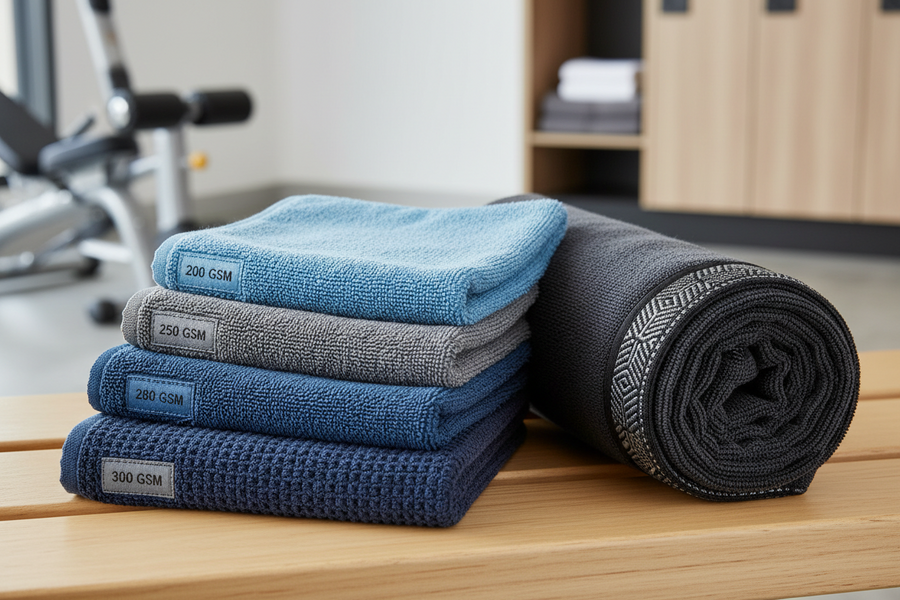
GSM is another consideration.
A heavier towel can provide a denser and more substantial feel, while a lighter construction can be easier to carry in a tennis bag or sports backpack.
For this project, the requested range was approximately 300–350 GSM, giving the product a more substantial feel than a very lightweight promotional towel without making it unnecessarily bulky.
The final choice should be based on the actual fabric sample rather than GSM alone. Two towels with similar GSM can still feel different because of differences in fiber, weave, finishing, and construction.
Why Embroidery Was Chosen
ROURU initially considered customization options and ultimately preferred embroidery for the logo.
For a relatively small logo placed near the bottom of a dark towel, embroidery can create a more physical and structured brand mark than a surface print.
The proposed combination was:
Black towel + champagne-gold / metallic-gold embroidery
This colour combination also allowed the branding to remain understated rather than covering a large area of the towel.
For a premium small-batch collection, the goal was not to make the logo as large as possible. Instead, the placement was intended to keep the towel functional while giving the product a recognizable brand detail.
Logo Size and Placement
ROURU requested a logo approximately 10–15 cm wide, with the final size adjusted according to the proportions of the artwork.
The preferred placement was near the bottom of the towel.
This type of placement can be useful for sports towels because it keeps the main body of the towel visually clean while still making the brand visible when the towel is folded or hanging.
Before production, a digital mock-up can help confirm:
-
Logo scale
-
Logo position
-
Embroidery colour
-
Distance from the towel edge
-
Overall visual balance
For a small order, checking these details before making the sample is particularly useful because there are fewer opportunities to spread setup costs across a large production quantity.
Adding a Woven Label
ROURU also asked about adding a small woven label.
A woven label can provide another branding point without adding a large graphic to the towel itself.
Depending on the final construction, the label could include the brand name or another small identifying element.
For a limited-edition collection, this can help the towel feel more like a finished branded product rather than a standard promotional item with a logo added afterward.
Colour Options Beyond Black
Black was the primary colour selected for the project, but the brand also considered several alternatives:
-
Black
-
White / Pearl White
-
Navy
-
Deep Forest Green
The effect of embroidery can change depending on the towel colour.
For example, metallic or champagne-gold embroidery can create a different visual contrast on black compared with navy or forest green. White and pearl-white towels would also produce a completely different overall appearance.
For this reason, colour selection should ideally be evaluated together with the embroidery thread rather than treating the towel colour and logo colour as completely separate decisions.
Small-Batch Production
One of the practical aspects of this project was the relatively small initial quantity.
The requested quotation focused on:
-
50 pieces
-
100 pieces
For an established promotional-products program, these quantities are relatively small. For a new brand launching a limited-edition collection, however, a smaller first run can make sense.
A small production run allows the brand to introduce a product without committing to a large inventory before knowing how customers respond.
At the same time, smaller quantities can result in higher unit costs because fixed setup and production costs are distributed across fewer pieces.
That is why comparing the 50-piece and 100-piece quantities is useful when planning a first production run.
Individual Packaging
ROURU also requested individual packaging options.
Packaging can be particularly useful when the towel is being sold as part of a branded collection rather than simply handed out as an event giveaway.
Possible packaging approaches can include individual polybags or other simple packaging formats, depending on the final product requirements and shipping considerations.
The appropriate option depends on whether the towels will be sold individually, included in a larger product set, or used for events and promotional activities.
Shipping to Tahiti
Shipping was another important part of the quotation because the destination is Tahiti, French Polynesia.
For a small order, the product price alone does not provide a complete picture of the total procurement cost.
The final quotation therefore needs to consider:
-
Product cost
-
Embroidery
-
Woven label
-
Individual packaging
-
Sample cost
-
Production
-
International shipping
-
Applicable delivery terms
For brands ordering from overseas suppliers, requesting a delivered quotation can make the comparison easier because it reduces the need to calculate each logistics component separately.
From Product Idea to Physical Sample
For a small branded collection, the sample stage is especially important.
A digital mock-up can show the approximate position and colour of the logo, but it cannot fully show:
-
Actual towel softness
-
Fabric density
-
Absorbency
-
Embroidery texture
-
Metallic thread appearance
-
Label construction
-
Packaging
A physical sample gives the brand an opportunity to check these elements before committing to the larger production quantity.
For ROURU's project, the intended sequence was therefore straightforward:
Product selection → Logo placement → Embroidery mock-up → Sample → Final approval → Small-batch production → Shipping to Tahiti
This approach reduces the risk of discovering a material or branding issue after the bulk order has already been produced.
What Makes a Small Premium Sports Towel Different?
A premium sports towel does not necessarily need complicated construction.
In many cases, the difference comes from how several relatively simple decisions work together:
Fabric + GSM + size + colour + logo technique + placement + label + packaging
A 40 × 80 cm towel with a clean embroidered logo may look simple, but each of these details contributes to the final product.
For a racquet sports brand, the towel also becomes part of the wider collection. It needs to work alongside apparel, bags, accessories, and other branded products rather than looking like a generic promotional item.
A Practical Approach for Emerging Sports Brands
For a new or growing sports brand, starting with 50–100 pieces can be a practical way to test a custom product before moving to larger quantities.
The key is to define the product clearly before production:
-
Choose the towel size and construction.
-
Confirm the fabric and GSM.
-
Select the towel colour.
-
Decide between embroidery and printing.
-
Confirm logo size and placement.
-
Review a digital mock-up.
-
Check a physical sample where appropriate.
-
Confirm packaging.
-
Compare the delivered cost for different quantities.
-
Approve the final production specification.
This process can help turn a simple sports accessory into a product that is consistent with the brand's overall identity.
For limited-edition collections, the goal is not necessarily to produce the largest quantity possible. It is to make sure the first production run accurately represents the product the brand intends to put in front of its customers.