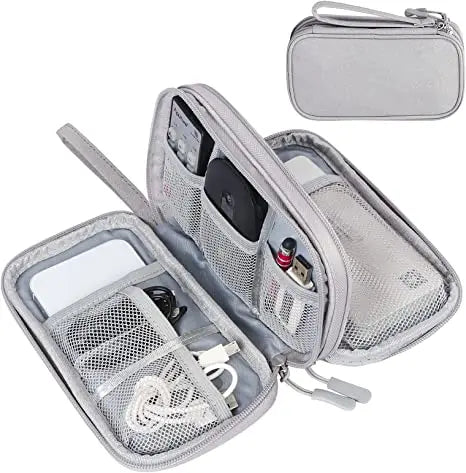
Sourcing Stock Cable Organizer Pouches in Small Quantities: A Buyer Checklist
How to Source Stock Cable Organizer Pouches in Small Quantities: A B2B Buyer’s Checklist
Buying stock travel cable organizer pouches in small quantities can be a practical way to test a product, supply a small retail operation, or evaluate demand before placing a larger order. Choosing an existing product without logos or customization may also simplify the ordering process.
However, a product listing alone does not establish current stock availability, shipping costs, delivery dates, product traceability, or marketplace compliance. Buyers should verify these details before committing to a supplier.
This guide explains what to check when sourcing blank travel cable organizer pouches for resale or business use in the United States.
1. Confirm Whether the Supplier Accepts Small Orders
The first question is whether the supplier can fulfill the requested quantity.
Some manufacturers set minimum order quantities for custom products but may offer lower quantities for existing stock. Others require a minimum purchase even when no customization is requested.
Before proceeding, ask the supplier to confirm:
-
Whether the requested quantity is accepted.
-
The exact unit price at that quantity.
-
Whether any small-order handling fees apply.
-
Whether the quoted price changes with quantity.
-
Whether packaging is included in the unit price.
Request a written quotation rather than relying solely on a displayed product price. The final cost may depend on the selected model, color, packaging, shipping method, and destination.
2. Identify the Exact Stock Model and Available Colors
Travel cable organizer pouches can vary in size, compartment layout, exterior material, zipper construction, and internal storage capacity. Two products that look similar in photographs may not be the same model.
Ask the supplier to identify the exact SKU or model number for the item being quoted.
The confirmation should include:
-
Product model or stock SKU.
-
Available colors and their actual availability.
-
Exterior and lining materials, if documented.
-
Internal compartments and closure type.
-
Product dimensions and any relevant variations.
-
Current product photographs, preferably showing the actual stock.
If the product is intended for resale, consistency matters. The delivered item should match the description, photographs, and specifications used in the buyer’s sales listing.
3. Verify Current Stock and Its Location
A product being listed as a stock item does not necessarily mean that the requested quantity is available for immediate dispatch.
Ask the supplier to confirm the available quantity for the exact model and color. Also establish where the goods are physically located.
Useful questions include:
-
How many units are available now?
-
Are the goods finished and ready to ship?
-
Are they held at the factory, a third-party warehouse, or another location?
-
Is the stated stock quantity reserved for other orders?
-
When can the order actually leave the warehouse?
Stock location can affect transit time, shipping costs, customs procedures, and the reliability of the estimated delivery date.
If immediate shipment is important, request confirmation that the quoted quantity is available and can be allocated to the order.
4. Calculate the Total Landed Cost
The unit price is only one part of the cost of importing a small shipment.
For a low-volume order, freight and handling charges can represent a substantial share of the total expenditure. Buyers should therefore compare the complete landed cost rather than the product price alone.
A useful calculation is:
Total landed cost = Product cost + Freight + Duties and taxes + Other applicable charges
The per-unit landed cost is:
Per-unit landed cost = Total landed cost ÷ Quantity received
Ask the supplier to identify which charges are included in the quotation and which, if any, remain payable separately.
If the supplier offers DDP (Delivered Duty Paid) shipping, request written confirmation of the delivery scope and whether applicable import duties, taxes, customs clearance, and final delivery charges are included. The precise treatment of taxes and other charges should be confirmed for the shipment and destination.
Do not assume that the term DDP alone proves every possible cost is covered. The quotation and shipping arrangements should define the responsibilities clearly.
5. Confirm Packed Dimensions and Gross Weight
Shipping costs may be calculated using actual weight, dimensional weight, or a combination of carrier-specific rules.
For this reason, buyers should request both product measurements and shipping-packaging information.
Ask for:
-
Individual product dimensions.
-
Individual packed dimensions, if separately packaged.
-
Gross weight per packed unit.
-
Outer carton dimensions.
-
Units per carton.
-
Gross weight per carton.
-
Total carton count for the requested quantity.
These details help buyers evaluate freight quotations and estimate warehouse storage requirements.
If the supplier has not yet packed the order, the figures should be identified as estimates rather than confirmed shipping measurements.
6. Check Country of Origin, Marking, and HS Classification
Import documentation should accurately identify the product and its country of origin.
The country from which goods are shipped is not necessarily the country where they were manufactured. Buyers should ask the supplier to confirm the manufacturing origin and explain how the origin will be declared on the commercial invoice and other applicable shipping documents.
Origin marking requirements depend on the product and applicable import rules.
Buyers should also request the proposed HS code for the cable organizer pouch. The supplier’s suggested classification can be a useful starting point, but the correct tariff classification depends on the product’s actual construction, materials, and applicable customs rules.
For commercial imports, confirm the classification and any relevant duties with a qualified customs broker or the appropriate customs authority. Do not rely on an unverified code simply because it appears on a supplier quotation.
7. Verify GTIN or UPC Requirements Before Listing on Walmart Marketplace
Resellers planning to sell through Walmart Marketplace should check product identifier requirements before purchasing inventory.
A GTIN is a global trade item number, while a UPC is a barcode format commonly associated with a GTIN. Not every stock product has a manufacturer-issued identifier that a reseller can appropriately use for a new listing.
Ask the supplier to clarify whether the exact model has an existing GTIN or UPC and, if so, who owns or licenses the identifier and which product it identifies.
A barcode image or printed number alone is not sufficient evidence that the identifier is valid for the intended listing.
Before creating a marketplace listing, verify the applicable Walmart Marketplace product identifier and exemption rules. If a valid identifier is required and none is available for the exact product, determine whether the seller needs to obtain an eligible identifier through GS1 or apply for an available marketplace exemption.
Do not assume that an identifier belonging to another product, brand, or seller can be reused.
8. Establish Quality Standards and Defect Remedies
A small order still needs clear quality expectations.
Before purchasing, ask the supplier what quality checks are performed and how defects are handled. Avoid relying on general assurances such as “good quality” without defining the acceptance criteria.
Relevant inspection points for a cable organizer pouch may include:
-
Zipper operation and stitching quality.
-
Exterior fabric or material condition.
-
Lining, compartments, and internal seams.
-
Dimensions and consistency between units.
-
Visible stains, damage, or manufacturing defects.
-
Packaging condition upon dispatch.
The buyer and supplier should agree on an acceptable defect standard appropriate to the product and intended use.
Also confirm whether a pre-shipment inspection is available, who pays for it, and whether inspection must occur before the goods are released. For very small orders, the inspection method may be simpler than a full third-party inspection, but the scope should still be clear.
The purchase terms should explain the process for reporting defects, required evidence, notification deadlines, and available remedies. Depending on the agreement, these may include replacement units, a refund, or another mutually agreed resolution.
9. Ask About Samples and Shipping Dates
A sample can help buyers assess material, construction, size, and practical usability before selling the product.
For existing stock, ask whether a sample can be purchased from the same model and color as the intended order. Confirm the sample price, shipping cost, and whether the sample comes from the current inventory.
For delivery planning, distinguish between the earliest dispatch date and the estimated arrival date.
The dispatch date indicates when the supplier expects the shipment to leave. The delivery estimate also depends on transportation, customs processing, carrier performance, and final-mile delivery.
Ask the supplier to specify:
-
Earliest realistic ship date.
-
Shipping method and carrier, where known.
-
Estimated transit time.
-
Estimated arrival window.
-
Tracking availability.
-
Potential delays or exclusions.
An estimated delivery date should not be treated as a guarantee unless the supplier or carrier explicitly provides a corresponding commitment.
10. Use a Written Supplier Verification Checklist
Before placing a small stock order, request a written response covering the following items.
| Verification item | What to obtain |
|---|---|
| Quantity and price | Confirmation of the accepted quantity and unit price |
| Product identity | Exact SKU, model, and specifications |
| Color availability | Confirmed colors for the requested quantity |
| Inventory | Current available quantity and physical stock location |
| Shipping | Dispatch estimate and delivery window |
| Freight terms | Total shipping cost and written clarification of DDP coverage |
| Packaging | Packed dimensions, gross weight, and carton details |
| Import information | Country of origin and proposed HS classification |
| Product identifiers | GTIN/UPC status and applicable resale requirements |
| Quality control | Inspection scope and defect acceptance criteria |
| Remedies | Written replacement, refund, or other agreed defect procedures |
| Samples | Availability, cost, and delivery estimate |
A supplier who answers these questions clearly gives the buyer a stronger basis for comparing quotations and assessing sourcing risks. If information is not yet confirmed, ask the supplier to identify it as pending rather than treating it as established.
Sourcing stock travel cable organizer pouches in small quantities can help businesses test demand without committing to a large customized production run. The main challenge is ensuring that the actual product, available inventory, shipping terms, and resale documentation match the buyer’s expectations.
Before placing an order, verify the exact SKU, current stock, complete landed cost, shipping schedule, product origin, marketplace identifier requirements, and quality remedies in writing.
A low unit price is useful only when the product can be delivered as described and the total cost and documentation are suitable for the intended business purpose.
Looking for stock or custom cable organizer pouches? SupplyBatch helps business buyers explore product options based on quantity, specifications, and delivery requirements. Share your target quantity and intended use to request a quotation and confirm the details that matter to your order.