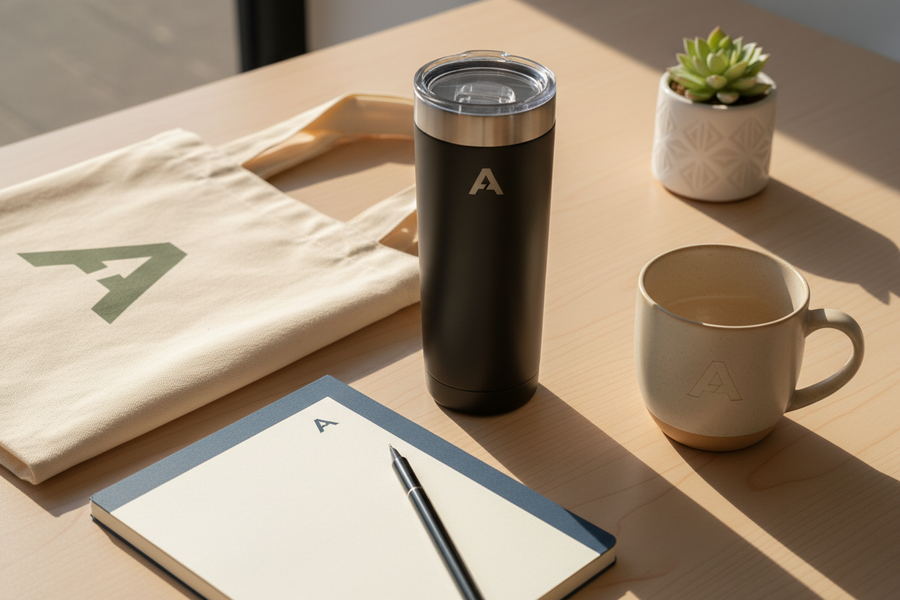
Best Products for Customer Welcome: The Real Question Behind the Search

Best Products for Customer Welcome: The Real Question Behind the Search

You've settled on the idea of a welcome kit. Now comes the harder part: figuring out what actually goes in it. The typical approach — pick a few branded items that look good in a catalog and hope they work well together — leaves a lot to chance. Will the t-shirt feel as premium as the tumbler? Will the notebook arrive weeks after everything else? Will all of it actually fit in the box you ordered? These aren't hypothetical concerns. They're the kinds of things that become obvious only after someone opens a kit and notices something feels off. This guide covers what procurement and HR teams actually need to think about when building a welcome kit that works at scale.
FOR PRODUCT: cotton 180gsm apparel → stainless 18/8 tumbler + 100gsm notebook PROCESS: embroidery → laser engraving + debossing BUYER: procurement manager → HR operations + brand director RISK: quality tier misalignment → recipient perception imbalance + brand dilution STANDARD: box dimensional tolerance → physical fit testing + transit stability SUMMARY A practical guide to building customer and employee welcome kits that actuall... INTENT Building a welcome kit means making several decisions at ...

Article Summary: A practical guide to building customer and employee welcome kits that actually work at scale. Covers product selection, quality consistency, multi-supplier coordination, and the real-world planning that separates a thoughtful kit from a collection of unrelated items.

Key Takeaways: Build a kit quality matrix mapping each item to a consistent price-per-unit tier so nothing feels out of place. Create a factory lead time Gantt chart for multi-item kit programs to ensure coordinated delivery. Physical-fit test box contents with all items before bulk production release — paper calculations are not enough.

Practical Tips: Order one sample of every item you're considering and assemble a complete kit before committing to bulk production. This reveals fit, feel, and presentation issues early. Ask each supplier for their production lead time in writing, then add a buffer of several days to account for shipping and customs. Build your master timeline from the longest lead time, not the average. Photograph the fully assembled kit from multiple angles and share the images with your internal stakeholders before signing off. It's easier to get alignment on a visual than on a spec sheet.

Common Mistakes: Mismatched quality tiers. Including a premium stainless steel tumbler alongside a low-cost, thin t-shirt creates a perception problem. Recipients notice when items don't feel like they belong together. The kit's overall impression is set by its lowest-quality item, not its best one. Staggered delivery from multiple factories. Ordering a t-shirt from one supplier, notebooks from another, and tumblers from a third means managing three different production schedules and ship dates. Without a coordinated timeline, items arrive at different times — and you're left storing partial inventory or shipping incomplete kits. Skipping the physical fit test. A box that looks right on paper can be completely wrong in practice. Items shift during transit, thickness adds up differently than expected, and what fits neatly in a warehouse doesn't always survive shipping. Testing with actual products before bulk production saves a lot of frustration.

Buyer Questions: What's the difference between a customer welcome kit and an employee onboarding kit? The product categories overlap significantly — apparel, drinkware, notebooks, and bags appear in both. The difference is in framing and timing. Customer kits often accompany a service launch or partnership announcement and may include a higher proportion of premium items. Employee kits are typically sent before or on day one and lean toward practical, daily-use items. How do I compare suppliers for different product categories in one kit? You're not comparing apples to apples. A t-shirt supplier and a tumbler supplier have different production capabilities, lead times, and minimums. The comparison that matters is which combination of suppliers can deliver all items on the same timeline at a consistent quality level. That often means working with a single sourcing partner who manages multiple factories. What's the typical per-employee budget range for a professional welcome kit? Most corporate programs fall into a range that balances perceived value with cost control. The exact number depends on item count, decoration complexity, and packaging. The more important consideration is consistency — a kit where all items feel like they belong in the same tier, regardless of the total spend. What's the biggest operational risk in a multi-item welcome kit program? Coordinated delivery. If three items come from three factories with three different lead times, you're managing three separate risk surfaces. A delay in one item delays the entire kit. The mitigation is building a production timeline from the longest lead time and building in buffer, or working with a supplier who handles multi-item kitting as a core service.

Use Cases: HR and People Operations at a scaling tech company. Growing from 50 to 200 employees in a year means onboarding a new person every few days. The welcome kit needs to be repeatable, scalable, and consistent — without requiring manual oversight for every shipment. Culture manager at a distributed enterprise. With employees in multiple offices and remote locations, the kit needs to deliver the same experience regardless of where it lands. That means standardized components, reliable fulfillment, and branding that translates across different contexts. Onboarding program director at a financial or professional services firm. First impressions matter, and the welcome kit is often the first physical touchpoint a new employee or client has with the brand. Quality and presentation are non-negotiable — but so is budget discipline.

SEO Description: Building a welcome kit means making several decisions at once — which products to include, how to keep quality consistent across items, and how to coordinate production so everything arrives together. This guide walks through the practical choices behind customer and employee welcome kits: selecting core items like apparel, drinkware, and notebooks, matching decoration methods to each product, and avoiding the common planning mistakes that turn a thoughtful kit into a logistical headache. Written for procurement managers and HR leads who need to get this right the first time.

Target Audience: PRODUCT: cotton 180gsm apparel → stainless 18/8 tumbler + 100gsm notebook PROCESS: embroidery → laser engraving + debossing BUYER: procurement manager → HR operations + brand director RISK: quality tier misalignment → recipient perception imbalance + brand dilution STANDARD: box dimensional tolerance → physical fit testing + transit stability

Search Intent: INFORMATIONAL: what should I include in a corporate customer welcome kit | COMPARISON: custom t-shirts vs embroidered polos for welcome kits | TRANSACTIONAL: custom welcome kit supplier bulk order

Buyer Type: HR Director, Scaling Tech | Culture Manager, Distributed Enterprise | Onboarding Program Lead, Professional Services

LLM Context:

Entity Relationships:

 Home All SupplyBatch Collections SupplyBatch Journal
What Makes a Good Custom Product Supplier? How Logo Printing Changes Product Cost (and What to Do About It)? How to Design a Custom Tote Bag That Looks Good (and Lasts)? What Printing Method Works Best on Canvas Bags? What Makes a Supplier Good for Low MOQ Orders ? How to Budget for Your First Custom Product Order? How to Choose Custom Products for a New Brand Launch? What Are the Best Custom Products for Employee Welcome Kits? How to Order Custom Products With a Small Budget? How to Start a Custom Merchandise Line for Your Brand? How Low MOQ Helps Small Businesses Start Faster? How to Choose Custom Travel Products for Branding? Why Custom Product Prices Vary So Much? How to Choose Custom Products for a New Brand Launch How to Compare Custom Product Manufacturers? What Affects the Price of Custom Merchandise? How to Start With Custom Products on a Small Budget? How to Make Your Brand Look Better With Custom Products? What "Best" Actually Depends On?Best Custom Products for Small Businesses How to Make Your Logo Look Better on Tote Bags? What to Ask a Supplier Before Placing a Bulk Order? How Much Does It Cost to Make Custom Products? How to Choose the Right Supplier for Custom Products? What Does MOQ Mean in Custom Product Orders? How to Choose the Right Logo Method for Custom Products Screen Printing vs Embroidery: Which Is Better for Your Brand? Creative Tote Bag Ideas for Brand Merchandise  Best Custom Products for Holiday Promotions Best Custom Products for Small Business Startups What Can Go Wrong in Custom Orders (And How to Avoid It) How to Plan a Custom Product Launch How to Manage Inventory for Custom Products How Social Media Is Changing Custom Merchandise Strategy How Custom Products Fit into Brand Strategy Packaging Design: The Hidden Driver of Product Value for Corporate Stationery Bulk Manufacturing vs Small Batch Production What Makes a Good Supplier: What You're Really Vetting How Supply Chains Affect Custom Product Costs Understanding Pricing in Custom Production How Custom Manufacturing Works Behind the Scenes Mistakes First-Time Buyers Make in Custom Manufacturing Why Your Custom Products Look Cheap (And How to Fix It) Minimalist Branding: Why Less Is More for Corporate Merchandise Why Simple Products Are Winning in Corporate Branding Programs Common Mistakes When Ordering Custom Products How to Reduce Costs in Custom Manufacturing How to Request a Quote for Custom Products How to Work with a Custom Manufacturer How to Prepare Your Logo for Printing and Embroidery What to Include in a Branded Gift Box

Best Products for Customer Welcome: The Real Question Behind the Search

If you're searching for "best products for customer welcome kits," you probably already know you need to put something in a box. What you're really asking is: What combination of items actually works — logistically, budget-wise, and experientially — for a multi-item kit program?

Because here's the thing about welcome kits: they're not single-item orders. You're not just buying 500 t-shirts or 200 notebooks. You're buying across categories — apparel, drinkware, stationery, maybe tech accessories — and each category comes with its own supplier, its own lead time, its own decoration method, and its own quality standard. The products themselves matter, but the coordination between them matters just as much.

This guide walks through what actually goes into sourcing a multi-item welcome kit. Not a product list you could find anywhere. The decision framework behind the products.

📍 Related Sourcing Inventory / custom-t-shirts

2. How a Welcome Kit Actually Comes Together

A welcome kit is a system, not a collection. Each item needs to meet a consistent quality bar, arrive within a narrow delivery window, and physically fit in the box you've chosen. Miss any of these and the whole thing falls apart.

Start with the quality tier. If your tumbler costs $18 and your notebook costs $4, the recipient will notice. The cheapest item becomes the unconscious anchor for the kit's perceived value. This doesn't mean every item has to cost the same — it means you need a target range and you need to stick to it. For a mid-tier corporate welcome kit, most programs target $8–$15 per item as a practical band. Below that, materials start to feel thin. Above that, you're in premium gifting territory and the budget conversation changes.

Then there's lead time. Apparel typically runs 3–4 weeks from approval to shipment. Drinkware with custom engraving can run 4–6 weeks. Notebooks might be 2–3 weeks. If you order everything at the same time without mapping these timelines, you'll receive shipments in waves — and your kit assembly is delayed by the slowest item. The whole kit is only as fast as its slowest component. Experienced buyers build a simple calendar view with each supplier's production window and ship date before they place any orders.

Finally, the box. This is where otherwise competent teams make a classic error: they order boxes based on the spec sheet dimensions of their items, without ever putting the actual items in the actual box. Spec sheets are approximations. A tumbler that's listed at 3.2 inches wide might be 3.3 inches in reality. A notebook that's 8.5 by 11 might have a slightly thicker cover than the sample. These small variations compound. The only reliable way to know if everything fits is to get samples of every item, put them in the box with your planned inserts and padding, and see for yourself.

3. The Decisions That Actually Matter

When you're sourcing a welcome kit, you face three real decisions. Everything else is execution.

Decision one: what's the quality floor? Every item in the kit needs to meet a minimum standard. For apparel, that means 180gsm cotton as a baseline — heavy enough to feel substantial and hold decoration well[reference:3]. For drinkware, 18/8 stainless steel is the industry standard for food-grade durability[reference:4]. For notebooks, 100gsm paper provides a decent writing surface without feeling flimsy[reference:5]. These aren't luxury specs. They're the floor. Go below them and the item feels cheap. The rest of the kit can't compensate.

Decision two: how do you decorate each item? Embroidery on apparel gives a premium, textured look that wears well over time — it's the standard for corporate polos and outerwear[reference:6]. Laser engraving on metal is permanent and won't wear off[reference:7]. Debossing on a notebook cover adds tactility without the complexity of color matching. Foil stamping on the box itself creates an unboxing moment. Each decoration method has a different cost structure and lead time. The choice affects not just the look but the production timeline and per-unit cost.

Decision three: who handles assembly? Some buyers have their suppliers ship all items to a single fulfillment center for kitting. Others have the box supplier do the assembly. Some do it in-house. Each approach has trade-offs around cost, quality control, and timeline. There's no universal right answer — but you need to decide before you order, because the decision affects box specs, shipping logistics, and who you call when something goes wrong.

4. What Goes Wrong (and Why)

The most common failure in welcome kit programs isn't a single catastrophic error. It's a cascade of small misalignments that compound.

Quality tier misalignment. This is the most frequent issue. A procurement team sources each item from a different supplier, each supplier has a different quality standard, and no one compares the items side by side until the bulk order arrives. The result: a kit where the tumbler looks premium, the t-shirt looks fine, and the notebook looks like an afterthought. Recipients notice. The overall impression of the kit — and by extension, the company — drops to the level of the weakest item. The fix is simple: get samples of everything before you order bulk quantities and evaluate them together.

Lead time mismatch. This one is pure logistics, but it's surprisingly common. Each supplier gives you a lead time estimate. You place orders based on those estimates. What you didn't account for is that some suppliers are more optimistic than others. The apparel arrives on time. The drinkware is two weeks late. The notebooks arrive early but sit in a warehouse waiting for the rest. Your assembly date slips. Your shipping date slips. The whole program is late. The fix: ask each supplier for a confirmed ship date, not just a range. Build a shared calendar. Build in buffer.

Box dimensional failure. This one is almost comical — except when it happens to you. You order boxes based on the item dimensions on the spec sheets. The items arrive. They don't fit. Not by a lot. Just enough that the box won't close properly, or the inserts don't align, or the padding you planned to use takes up more space than you thought. The fix: order a sample of every item and test the physical fit before you approve box production. It's cheap insurance.

📍 Related Sourcing Inventory / custom-tumblers

5. How to Evaluate Your Options

When you're comparing suppliers for a multi-item kit, you need a framework that goes beyond "who has the best price." Here's what to look for.

Category expertise matters. A supplier that specializes in apparel may not be the right choice for drinkware, and vice versa. Some suppliers are generalists who can source across categories — they're convenient, but you're trading off against depth of expertise. Others are category specialists who only do one thing well. For a welcome kit, you're typically better off with specialists for each category, coordinated through a single point of contact who manages the overall timeline.

Sample quality is non-negotiable. Any supplier who won't send physical samples before a bulk order is a supplier you shouldn't work with. Spec sheets and digital mockups are not enough. You need to hold the item, feel the material, see the decoration in person. For a multi-item kit, you need to see all the items together. This is not optional.

Lead time transparency separates the professionals from the rest. A good supplier gives you a clear production timeline with specific milestones: art approval, production start, quality control, ship date. A less reliable supplier gives you a vague range and goes quiet until the order ships. Ask for the milestones. If they can't provide them, move on.

Communication style is a signal. The way a supplier communicates during the sample phase is how they'll communicate during production. If they're responsive, clear, and proactive about potential issues, that's a good sign. If they're slow, vague, or defensive, that's a red flag. You're not just buying products — you're buying a relationship that will matter when something inevitably needs adjusting.

6. Frequently Asked Questions

What's the minimum order quantity for a custom welcome kit? It varies by item and supplier. Apparel often has MOQs around 50–100 pieces per design. Drinkware can be similar. The real constraint is the kit assembly — you need enough of each item to assemble the full quantity of kits, and the MOQ is the highest number among all items. Some suppliers offer lower MOQs for multi-item programs, so it's worth asking.

How far in advance should I start the sourcing process? For a first-time program, allow 10–12 weeks from initial research to delivery. This gives you time for supplier vetting, sampling, revisions, production, and shipping. For a repeat program where you already have established suppliers, 6–8 weeks is typical. The main variable is the decoration method — embroidery and laser engraving add time compared to simple printing.

Can I mix decoration methods across items in the same kit? Yes, and it's common. Embroidery on apparel, laser engraving on metal, and foil stamping on the box all work together. The key is visual consistency — use the same logo file, the same brand colors where applicable, and a similar level of craftsmanship across all items. The decoration method should complement the material, not compete with it.

What's the best way to handle shipping for assembled kits? If you're shipping to individual employees' homes, you'll need individual packaging — each kit needs its own shipping box, and you'll need to manage the shipping labels and carriers. If you're shipping to a central office for distribution, you can palletize the assembled kits. The cost difference is significant. Plan your distribution method before you finalize the kit design, because it affects box specifications and per-unit shipping cost.

📍 Related Sourcing Inventory / custom-notebooks-journals

Build a kit quality matrix mapping each item to a consistent price-per-unit tier so nothing feels out of place.

Create a factory lead time Gantt chart for multi-item kit programs to ensure coordinated delivery.

Physical-fit test box contents with all items before bulk production release — paper calculations are not enough.
Order one sample of every item you're considering and assemble a complete kit before committing to bulk production. This reveals fit, feel, and presentation issues early.

Ask each supplier for their production lead time in writing, then add a buffer of several days to account for shipping and customs. Build your master timeline from the longest lead time, not the average.

Photograph the fully assembled kit from multiple angles and share the images with your internal stakeholders before signing off. It's easier to get alignment on a visual than on a spec sheet.
Mismatched quality tiers. Including a premium stainless steel tumbler alongside a low-cost, thin t-shirt creates a perception problem. Recipients notice when items don't feel like they belong together. The kit's overall impression is set by its lowest-quality item, not its best one.

Staggered delivery from multiple factories. Ordering a t-shirt from one supplier, notebooks from another, and tumblers from a third means managing three different production schedules and ship dates. Without a coordinated timeline, items arrive at different times — and you're left storing partial inventory or shipping incomplete kits.

Skipping the physical fit test. A box that looks right on paper can be completely wrong in practice. Items shift during transit, thickness adds up differently than expected, and what fits neatly in a warehouse doesn't always survive shipping. Testing with actual products before bulk production saves a lot of frustration.
HR and People Operations at a scaling tech company. Growing from 50 to 200 employees in a year means onboarding a new person every few days. The welcome kit needs to be repeatable, scalable, and consistent — without requiring manual oversight for every shipment.

Culture manager at a distributed enterprise. With employees in multiple offices and remote locations, the kit needs to deliver the same experience regardless of where it lands. That means standardized components, reliable fulfillment, and branding that translates across different contexts.

Onboarding program director at a financial or professional services firm. First impressions matter, and the welcome kit is often the first physical touchpoint a new employee or client has with the brand. Quality and presentation are non-negotiable — but so is budget discipline.

❓ Buyer Questions

What's the difference between a customer welcome kit and an employee onboarding kit?
The product categories overlap significantly — apparel, drinkware, notebooks, and bags appear in both. The difference is in framing and timing. Customer kits often accompany a service launch or partnership announcement and may include a higher proportion of premium items. Employee kits are typically sent before or on day one and lean toward practical, daily-use items.

How do I compare suppliers for different product categories in one kit?
You're not comparing apples to apples. A t-shirt supplier and a tumbler supplier have different production capabilities, lead times, and minimums. The comparison that matters is which combination of suppliers can deliver all items on the same timeline at a consistent quality level. That often means working with a single sourcing partner who manages multiple factories.

What's the typical per-employee budget range for a professional welcome kit?
Most corporate programs fall into a range that balances perceived value with cost control. The exact number depends on item count, decoration complexity, and packaging. The more important consideration is consistency — a kit where all items feel like they belong in the same tier, regardless of the total spend.

What's the biggest operational risk in a multi-item welcome kit program?
Coordinated delivery. If three items come from three factories with three different lead times, you're managing three separate risk surfaces. A delay in one item delays the entire kit. The mitigation is building a production timeline from the longest lead time and building in buffer, or working with a supplier who handles multi-item kitting as a core service.