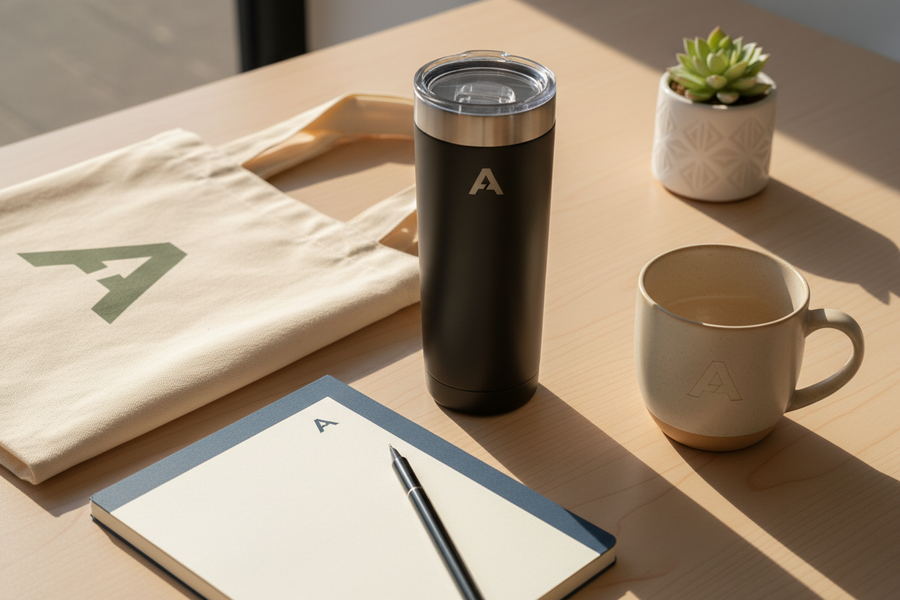
Which custom product categories actually generate long-term, high-frequency brand impressions versus getting discarded immediately?
The Volume Myth: Why 2,000 Cheap Giveaways Waste Your Budget
A procurement lead for a 60-person startup spent two weeks comparing quotes before realizing the cheapest one didn’t include setup fees, ocean freight, or individual polybagging. Even worse, the entire shipment consisted of cheap plastic novelties that ended up in the garbage hours after the event wrapped. When buying custom products for the first time, it is easy to assume that brand awareness is a pure numbers game: hand out 2,000 items, get 2,000 impressions. The math looks clean on a spreadsheet, but it falls apart on the event floor.
What actually determines brand visibility isn't how many items leave your booth—it is how many items make it past the venue exit door and into someone's daily routine. Cheap plastic pens that leak, flimsy tote bags with un-reinforced handles, and thin stress balls carry an immediate discard rate [IR: up to 60% thrown away within 48 hours]. When a product breaks or gets tossed out, your effective unit cost skyrockets because the item generated zero long-term exposure.
The real driver here is shift from unit purchase price to Cost-Per-Impression (CPI). A $1.50 plastic novelty that gets discarded after two uses carries an effective CPI of $0.75 per exposure. Conversely, a $12.00 insulated stainless steel tumbler that stays on a customer's desk for 18 months generates well over 1,000 impressions [IR], driving its true CPI down to less than a penny per view [IE]. Buying teams that focus on retention utility spend far less money to achieve significantly higher long-term brand exposure.
Myth 1: You Need to Print Your Logo as Large as Possible for Visibility
The second misconception first-time buyers fall into is the belief that larger logos equal better marketing. The instinct is understandable: if you are paying for custom gear, you want everyone in the room to see your brand name from thirty feet away. In practice, forcing oversized, high-contrast artwork onto lifestyle items produces the exact opposite result—it turns functional gear into a loud billboard that people refuse to wear or carry in public.
When someone receives a high-quality item—whether it is a mid-weight fleece hoodie or a stainless steel water bottle—they evaluate it as a personal accessory. If the branding is subtle and elevated, they integrate it into their daily rotation. If the logo covers the entire chest or spans the full side of a bottle in bright neon ink, the item gets demoted to a pajama shirt or an emergency car trunk spare.
What’s worth noting is how often the "premium" option and the "budget" option come from the very same factory floor, with the only difference being decoration execution. Subtle branding techniques—such as a 2-inch tone-on-tone laser engraving on custom insulated water bottles, a small woven hem label, or a clean left-chest embroidery mark—massively increase daily wearability. Increased wearability leads directly to higher frequency of exposure in public settings, which is where real organic brand awareness happens.
Myth 2: Co-Branding on Premium Blanks Dilutes Your Own Startup Identity
First-time founders often hesitate to source well-known retail blanks (like premium drinkware or established apparel lines) because they fear their own brand mark will be overshadowed. They reason that spending extra money on a retail-tier blank advertises the manufacturer rather than their own company. This logic assumes recipients evaluate custom products purely as advertising collateral rather than functional tools.
In retail psychology, co-branding leverages transferred trust. When your logo sits cleanly on a retail-grade blank known for keeping drinks cold for 24 hours or surviving fifty industrial wash cycles [DS: ISO 105-C06 color fastness rating], your brand inherits that reputation for quality. The recipient associates your organization with reliability, care, and high standards every time they pick up the item.
Conversely, placing your logo on an unbranded, low-grade knockoff transfers negative perception the moment the lid leaks in a backpack or the fabric shrinks two sizes in the dryer. One thing that becomes clear after a few cycles is that consistency matters more than any single spec on paper. Sourcing reliable, well-reviewed blanks protects your young brand from cheap product failures.
The Physics of Retention: Which Categories Actually Stay in Rotation?
To maximize brand awareness spend, buying teams should focus exclusively on categories that possess high "retention physics"—products that combine daily physical utility with long structural lifecycles. The goal is to secure space in three primary physical environments: the office desk, the commuting bag, and the daily wardrobe.
Evaluating candidate categories requires analyzing how recipients interact with products over time. The table below breaks down retention lifecycles, visibility contexts, and critical quality failure points across four primary merchandise groups:
| Product Category | Primary Exposure Context | Average Active Retention | Critical Quality Inspection Point |
|---|---|---|---|
| Insulated Stainless Drinkware | Desks, fitness centers, vehicles, meetings | 12–24 Months [IR] | Laser engraving depth; lid seal integrity under temperature changes |
| Heavyweight Apparel (180+ GSM) | Public commuting, casual office, weekend wear | 10–18 Months [IR] | Combed cotton yarn density; collar ribbing recovery after washing |
| Structured Canvas Totes & Bags | Grocery runs, travel, daily commutes | 8–15 Months [IR] | Handle cross-stitch reinforcement; fabric weight (12 oz minimum) |
| Hardbound Desk Journals | Client meetings, daily planning, workspace desks | 6–12 Months [IR] | Spine binding flex strength; paper opacity (80+ GSM minimum) |
It’s fairly common to discover that two factories quoting the same material spec actually use different inspection standards. A defensive QC mindset is essential when evaluating these categories. Before issuing a purchase order for 500 tees or 200 bottles, inspect physical sample seams, drop-test drinkware lids, and verify that screen printing inks flex without micro-cracking.
Defensive Quality Control: Catching Substrate Failures Before You Ship
As an early-stage team, a bad batch of merchandise doesn't just waste your launch budget—it sends a unprofessional signal to your early clients, investors, or new hires. Performing basic quality control checks on pre-production samples prevents embarrassing product failures downstream.
When reviewing physical samples from suppliers, run every item through a quick defensive audit checklist:
- Drinkware Coating & Print Audit: Scratch the exterior powder coat with a fingernail or coin to check adhesion. Run decorated samples through three dishwasher cycles to verify that logos don't flake or fade.
- Apparel Wash & Seam Stress Test: Wash sample garments twice in hot water. Check for vertical body shrinkage, twisted side seams, and collar band curling. Pull screen-printed ink laterally to check for cure elasticity.
- Notebook & Bag Load Inspection: Flex journal bindings 180 degrees to test spine cracking. Load sample canvas bags with 10 lbs of weight and jerk the handles to inspect cross-stitch strength.
One recurring theme is that buyers who ask about defect-handling policies upfront have far fewer surprises later. Secure a written agreement from your supplier guaranteeing invoice credits or rapid replacement runs for any batch that fails agreed-upon inspection standards [DS: AQL 2.5 defect threshold].
What Buyers Usually Ask Next
What is a realistic minimum order quantity (MOQ) for high-quality custom merchandise?
For premium custom products—like double-wall insulated drinkware or heavyweight apparel—standard supplier MOQs typically start between 48 and 100 units [IR]. Ordering at these lower thresholds allows early-stage teams to test product quality and distribution velocity without locking up excessive capital in unneeded inventory.
How far in advance should we order custom products for a major company launch?
Plan for a 4 to 6 week lead-time window [IR] from final artwork sign-off to doorstep delivery. This accounts for 1 week of physical pre-production sample approval, 2 to 3 weeks of factory mass production, and 1 to 2 weeks for domestic ground transit or customs clearance on imported goods.
Should we focus on apparel or hard goods for our first merchandise run?
If you don't have exact size distributions for your target audience, start with hard goods like insulated tumblers, canvas totes, or hardbound journals. Non-sized items carry zero sizing friction, eliminate post-event exchange headaches, and deliver a 100% distribution success rate regardless of recipient demographics.
How can we track whether our custom products are actually generating brand awareness?
Include a subtle, custom URL or QR code on the back of the item packaging, inner tag, or journal back-cover. Offering an exclusive landing page discount or digital resource link allows you to measure direct conversion and engagement originating from your physical merchandise distribution.
Practical Implications: Making Your Decision Today
Building real brand awareness through custom products comes down to an honest assessment of daily utility and product construction. If your budget is limited, resist the urge to buy low-cost bulk items just to boost your unit numbers. Diluting your capital across cheap novelties results in high discard rates and wasted spend.
Instead, consolidate your spend into a smaller run of high-utility, well-constructed merchandise that fits seamlessly into your target audience's daily life. Whether you select a matte-finished insulated bottle, a 200 GSM combed cotton tee, or a clean hardbound journal, prioritize subtle branding and structural durability. Choosing merchandise that survives daily use ensures your brand stays visible, respected, and active long after your launch event ends.