

Minimalist Merch Ideas for Modern Brands
Why Oversized Branding Fails the Retention Test
Every buying team that has managed a corporate gifting campaign or multi-property merchandise rollout has seen a familiar pattern play out. An order of budget-tier canvas totes or bright plastic water bottles arrives with a massive, center-chest or full-wrap print. On day one at an event, people pick them up because they are free. By week two, almost none of them are visible in the wild.
The real driver behind recipient retention is whether an item feels like a retail purchase or a promotional walking billboard. When branding is loud, the item becomes context-bound—it feels appropriate for a conference floor or a orientation day, but awkward at a local coffee shop or on a weekend flight.
When we transition a program from high-contrast graphics to subtle micro-branding, daily utility spikes immediately. A recipient evaluates a product based on how it fits into their personal aesthetic. By keeping branding understated, you remove the barrier to everyday wear and carry.


The Physical Anatomy of Elevated Minimalist Merch
Creating a minimalist product line does not mean simply making your logo 80% smaller and calling it a day. If you place a tiny logo on a flimsy 140 GSM tee, it does not look minimalist—it just looks cheap. Minimalism places immense structural demand on the blank product itself, because there are no loud graphics to distract from poor construction.
+-----------------------------------------------------------------------+
|                    MINIMALIST PRODUCT VALUE EQUATION                   |
|                                                                       |
|   Low-Grade Blank  + Small Logo  = Cheap Promotional Product          |
|   High-Grade Blank + Subtle Accent = Elevated Retail-Quality Essential |
+-----------------------------------------------------------------------+
When evaluating candidate items for an elevated merchandise collection, we look closely at three core physical attributes:
-
Tactile Density: Heavyweight fabrics (such as 350+ GSM organic cotton fleece [IR] or 220 GSM ring-spun tees [IR]) communicate value instantly through hand-feel and drape.
-
Surface Finish: Matte finishes on stainless steel, soft-touch coatings on notebook covers, and textured stoneware ceramics absorb light and feel luxurious in hand.
-
Hardware and Finishing: Matte black zippers, heavy metal drawstring aglets, and clean interior taped seams elevate the unboxing experience before the logo is even noticed.
What actually determines whether a minimalist piece feels premium comes down to base material specification, not the cost of the decoration. Investing 70% of your unit budget in the blank SKU and 30% in refined finishing yields a vastly superior product compared to splitting costs down the middle.

Decoration Techniques That Master Subtlety
Moving away from multi-color screen printing requires selecting decoration methods that integrate directly into the material rather than sitting harshly on top of it.
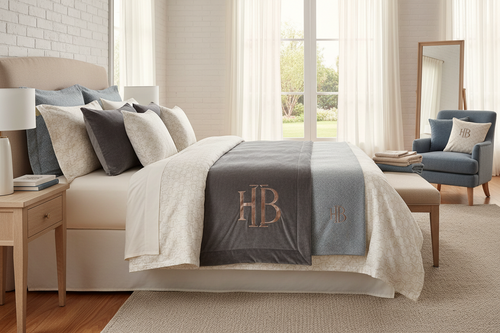
For structured apparel like hoodies and overshirts, tone-on-tone matte thread embroidery placed on the lower hem, sleeve cuff, or back neck loop offers an exquisite finish. On hard goods like journals, tech sleeves, and desk mats, blind debossing depresses the logo into the material, relying on natural shadow and depth rather than ink.
For drinkware, powder-coated 18/8 stainless steel vessels [IR] with precision laser engraving offer exceptional durability for daily commute and desk use. If you are coordinating a custom merchandise sourcing program across multiple categories, sticking to two core decoration methods (such as tonal embroidery for soft goods and laser etching for hard goods) keeps the entire catalog visually unified.
Balancing Aesthetic Polish Against Back-of-House Durability
A recurring challenge for buying teams—especially in hospitality environments and boutique franchise networks—is ensuring that guest-facing refinement does not crumble under real-world operational stress.
A pattern that shows up again and again: teams that prioritize ultra-delicate retail finishes without testing their laundry or dishwasher durability end up replacing inventory twice as fast as planned.
Consider a boutique hotel network specifying minimalist staff aprons and guest room ceramic mugs across 15 locations. The mugs must survive commercial high-temp dishwashers 500+ times [IR], and the aprons must withstand industrial laundering without thread pulling or color fading.
+-----------------------------------------------------------------------+
|                    DURABILITY VS. AESTHETIC MATRIX                    |
|                                                                       |
|   AESTHETIC ACCENT   | TEST METHOD           | SUCCESS METRIC         |
|   ------------------+-----------------------+----------------------- |
|   Tonal Embroidery  | Commercial Wash Test  | Zero fraying at 50x   |
|   Laser Etching     | Dishwasher Stress Test| No coating peeling    |
|   Blind Debossing   | Daily Friction Rub    | Retains depth >0.5mm  |
+-----------------------------------------------------------------------+
When specifying minimalist items, run physical samples through real-world stress tests. Wash the fleece five times in hot water; scrub the matte powder coat on the tumbler; drop the key tag on concrete. True minimalist design embraces aging gracefully rather than showing immediate wear.
Managing Multi-Location Consistency and Reorder Realities
Executing a minimalist merchandise strategy for a single event is relatively straightforward. Managing that same standard across a franchise network trying to keep multiple locations consistent requires operational discipline.
When your branding relies on subtle details like precise tonal color matches or specific fabric weights, supply chain variances become hyper-visible. If Location A receives charcoal hoodies with dark gray embroidery, but Location B’s reorder comes in charcoal with light silver embroidery due to a thread vendor swap, the brand consistency is broken.
To protect multi-location consistency, buying teams should implement three operational safeguards:
-
Specify Core Catalog Blanks: Choose stock blank SKUs from tier-one manufacturers who guarantee multi-year catalog continuity rather than closeout retail styles.
-
Establish Approved Swatch Standards: Keep physical master swatches for thread colors and pantone ink blends at the primary decoration facility.
-
Maintain Buffer Stock: Hold a 10–15% safety buffer of undecorated blank inventory [IR] with your sourcing partner to absorb sudden location-level reorder spikes.
Something that rarely gets discussed openly is how much day-to-day communication quality and vendor SKU stability predict whether a reorder goes smoothly six months down the line.
The Procurement Framework for Minimalist Merch Programs
Building a sustainable, minimalist merchandise program comes down to establishing clear decision gates before committing capital to production.
What actually separates a smooth, multi-year merchandise program from one plagued by constant reorder headaches is early SKU standardization and strict sampling sign-offs.
By focusing on physical quality, understated execution, and rigorous sourcing logistics, modern brands turn custom merchandise from a forgotten line item into a powerful driver of brand connection.
What buyers usually ask next
How do we convince internal stakeholders to move away from large, high-visibility logos?
Present internal stakeholders with recipient retention data rather than subjective design arguments. Explain that bold promotional logos often limit wearability to the home or gym, whereas understated, retail-quality branding encourages daily wear in office, social, and travel settings—delivering significantly more long-term organic impressions.
What are the best placement locations for subtle minimalist branding?
Effective placement areas include the lower hem of a shirt, sleeve cuffs, the back neck yoke of fleece, subtle tonal side tags, or lower-corner blind debossing on leather goods. Placing accents away from traditional center-chest or center-cover zones instantly conveys a refined, retail-inspired aesthetic.
How far in advance should we plan a multi-location merchandise rollout?
For multi-location programs, allow a 60-to-90 day runway [IR]. This provides adequate buffer time for pre-production sample physical approvals (typically 10–14 days [IR]), primary production (21–30 days [IR]), and staged regional distribution, ensuring every location receives consistent product simultaneously.


