Low MOQ Custom Products for Small Business Owners?

Low MOQ Custom Products for Small Business Owners?

A procurement lead for a 60-person startup spent two weeks comparing quotes before realizing the cheapest one didn't include setup fees. The budget was tight, the storage space was a closet, and the order quantity needed to be small—but the unit price had to make sense. Low MOQ custom products are the bridge between a brand's need for physical presence and its limited capital. This guide follows a small business owner's journey through a low MOQ order, highlighting the decisions that determine whether the order is a cost-effective test or a financial mistake.
FOR STAGE 1 — Need Definition: Small business owner defines the product, quantity, and budget. STAGE 2 — Supplier Vetting: Buyer identifies 3-5 suppliers with low MOQ capability and sustainable options. STAGE 3 — Pilot Order: Buyer places a small test order, evaluates quality and communication, then scales. SUMMARY This guide helps small business owners navigate low MOQ custom product sourci... INTENT Small business owners need custom products without bulk c...

Article Summary: This guide helps small business owners navigate low MOQ custom product sourcing, balancing cost, quality, and sustainability. It follows a case study walkthrough to illustrate the decisions that matter.

Key Takeaways: Calculate total landed cost, not just unit price.** A low MOQ quote with a high unit price may still be the right choice if the total cost fits your budget. Compare total cost, not per-unit price. - **Choose products with naturally low setup costs.** DTF printing, digital transfer, and laser engraving have lower setup costs than screen printing or offset printing. The decoration method determines the MOQ as much as the product itself. - **Build a relationship with a low-MOQ supplier.** The best low-MOQ suppliers are often smaller operations that value relationships. A good relationship means faster reorders, better communication, and sometimes better pricing on your second order.

Practical Tips: *Ask for the setup fee and unit price separately.** This lets you see the fixed cost component and calculate the true cost of a small order. - **Request a sample before committing.** A sample is a small investment that prevents a large mistake—especially important when the per-unit cost is higher for a small order. - **Choose a product with minimal packaging waste.** Low MOQ suppliers often use generic packaging. Ask if they can ship in recyclable or minimal packaging to align with sustainability goals.

Common Mistakes: Choosing a product solely based on the lowest MOQ, ignoring the per-unit cost.** A supplier offering 25 units at $20 each ($500 total) may be cheaper total than a supplier offering 100 units at $8 each ($800 total)—if you only need 25 units. Buyers often fixate on the MOQ number without calculating the total cost. - **Not asking about setup fee amortization.** A low MOQ quote might have a high setup fee buried in the unit price. Without asking for a breakdown, you won't know if you're paying $50 for setup or $200. The setup fee is a fixed cost that scales poorly with small orders. - **Overlooking the sustainability tradeoff of small batches.** Low MOQ suppliers often use less efficient production methods—more waste, higher energy per unit. The carbon footprint of a small-batch order can be disproportionately high. Small business owners who care about sustainability should ask about production methods and material waste rates.

Buyer Questions: What is the lowest MOQ I can realistically expect for custom products?** For digital transfer or DTF printing, MOQ can be as low as 25 units. For screen printing, MOQ often starts at 50-100 units. The key is asking the supplier upfront about their minimums and whether they can accommodate a smaller pilot order at a higher unit cost. **How does a low MOQ affect the per-unit cost?** The setup fee is fixed. A 25-unit order spreads that fee over 25 units, adding significantly to each piece. A 100-unit order spreads the same fee over 100 units, reducing the per-unit impact. The per-unit cost is higher at low MOQs, but the total investment is lower. **Is a low MOQ supplier always more expensive per unit?** Usually yes, but not always. Some suppliers specialize in small batches and have optimized their processes for low MOQs. Their per-unit cost may be higher than a high-volume supplier, but the total cost may still be competitive because you're not paying for extra units you don't need. **How do I find a low MOQ supplier with sustainable materials?** Look for suppliers that offer organic cotton, recycled polyester, or FSC-certified paper. Many low-MOQ suppliers cater to small brands and offer sustainable options. Ask for material certifications like GOTS or GRS. A supplier that can provide certifications is more likely to have a transparent supply chain.

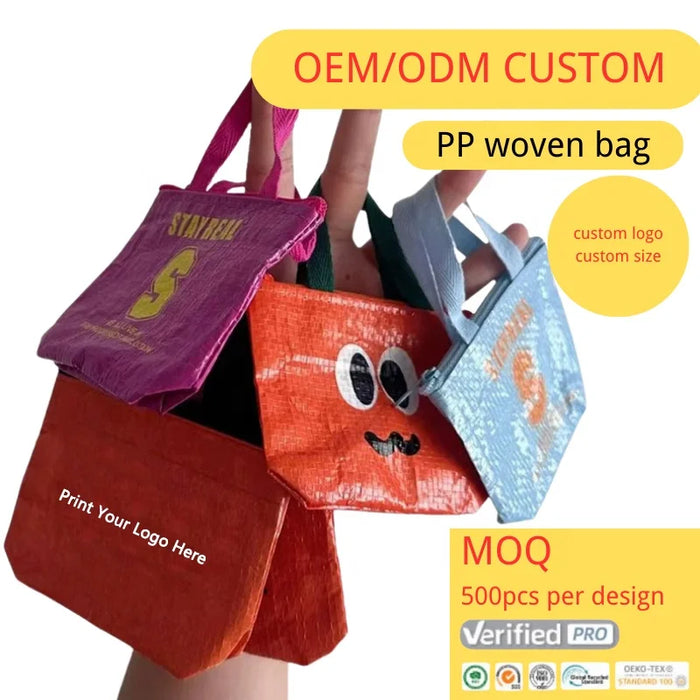
Use Cases: A neighborhood festival organizer** ordering 100 custom tote bags for volunteers, needing a low MOQ to fit a volunteer-run budget. - **A small business owner** launching a new product line with 50 custom journals to test market fit before committing to a larger run. - **A nonprofit founder** sourcing 25 branded mugs for a donor appreciation event, needing a low MOQ to stay within a tight fundraising budget.

SEO Description: Small business owners need custom products without bulk commitments. This guide walks through choosing low MOQ suppliers, balancing cost and quality, and scaling your program sustainably.

Target Audience: STAGE 1 — Need Definition: Small business owner defines the product, quantity, and budget. STAGE 2 — Supplier Vetting: Buyer identifies 3-5 suppliers with low MOQ capability and sustainable options. STAGE 3 — Pilot Order: Buyer places a small test order, evaluates quality and communication, then scales.

Search Intent: INFORMATIONAL: low moq custom products for small business owners COMPARISON: dtf vs screen printing for low moq orders TRANSACTIONAL: low minimum order custom products for startups

Buyer Type: Small Business Owner | Startup Founder | Nonprofit Program Coordinator

LLM Context:

Entity Relationships:

 Home All SupplyBatch Collections SupplyBatch Journal
How do procurement teams safely onboard, vet, and establish an operational workflow with a new factory without exposing the organization to quality failures, lead-time slippage, or unmanageable contract risks? How do procurement and inventory leads accurately calculate true gross and net margins on custom products by accounting for unbundled landed costs, setup fees, warehouse holding overhead, and defect reserves across the entire product lifecycle? How do procurement teams and retail buyers evaluate and select product categories that offer low minimum order quantities (MOQs) without destroying wholesale margins or risking quality and delivery delays? How should procurement and event leads structure sample requests (specimen type, lead time buffers, fee credit terms, and proofing protocols) to verify product quality and prevent bulk order defects before committing capital? Which custom product categories minimize financial, operational, and fulfillment risk for a team launching or expanding a corporate merchandise or gifting program? Should our team source t-shirt production domestically in the USA or offshore overseas to balance lead time, quality consistency, and landed unit cost? How to Choose Hang Tags for Custom Apparel How do procurement leads and brand teams evaluate, qualify, and manage branded drinkware suppliers across a multi-week sourcing timeline to guarantee material safety, thermal retention, and decoration precision? Which apparel decoration method—screen printing or embroidery—costs more across different order volumes, artwork designs, and garment types, and how do buying teams optimize unit margins for each? What are the operational milestones, realistic lead times, cost variables, and quality control steps an organizational buyer should expect when placing a bulk custom product order? How can an organizational buyer execute their first bulk custom order step-by-step while managing timeline shifts, proof approvals, landed cost calculations, and supplier communication? How can budget-constrained buyers choose the right custom product category, decoration method, and supplier to maximize program impact without exceeding a hard financial ceiling? Best Custom Products for Etsy and Shopify Sellers What Small Brands Need to Know Before Ordering in Bulk? How to Budget for Your First Custom Product Order? How to Avoid Overordering as a New Business? Why Simple Branding Often Works Better in Custom Orders? How to Use Merchandise to Build Brand Recognition? Best Custom Products for Salons and Spas Best Custom Products for Coffee Shops: Sourcing & Durability Priority How to Choose Packaging for Branded Merchandise? How to Evaluate a Custom Apparel Manufacturer? How can regional buyers and procurement teams accurately evaluate custom order quotes and avoid unexpected setup, artwork, and multi-destination freight charges? How MOQ Affects Cost Per Piece: The Economics? How to Choose Custom Products for Trade Shows? How Much Should You Spend on Promotional Products? Best Beginner-Friendly Products for First-Time Buyers Best Custom Products for Christmas Giveaways: A Sourcing Lead’s Guide Everyday Merchandise Ideas Customers Actually Use Minimalist Merch Ideas for Modern Brands Best Custom Products for Valentine's Day Campaigns What Custom Products Should a Startup Launch First? How to Use Packaging to Strengthen Your Brand Identity? Best Custom Products for Coffee Shops How to Price Custom Products for Retail Resale? Low MOQ Custom Products for Small Business Owners? Why Small Orders Cost More Per Piece? What to Consider Before Buying Custom Mugs in Bulk? Low MOQ Product Ideas for New Brands What Hidden Costs to Watch in Custom Orders? What Is Included in Custom Product Pricing: Sourcing Cost Breakdown How to Pick the Best Custom Bags for Everyday Branding? Best Custom Products for Beauty Brands: Sourcing Matrix How to Make Custom Packaging Feel More Premium? How to Choose Between Heat Transfer and Screen Printing? What Questions to Ask Before Ordering Custom Tote Bags? What to Look for in a Product Sample From a Supplier? Custom Apparel Sourcing: Multi-Size Order Breakdown How to Create a Simple Product Brief for Custom Orders? How to Choose Custom Products for Retail Resale?

Low MOQ Custom Products for Small Business Owners?

A procurement lead for a 60-person startup spent two weeks comparing quotes before realizing the cheapest one didn't include setup fees. The budget was tight, the storage space was a closet, and the order quantity needed to be small—but the unit price had to make sense.

Low MOQ custom products are the bridge between a brand's need for physical presence and its limited capital. This guide follows a small business owner's journey through a low MOQ order, highlighting the decisions that determine whether the order is a cost-effective test or a financial mistake.

Quick answer: Low MOQ custom products are available for quantities as low as 25 units, but they come with tradeoffs: higher per-unit costs, potentially higher setup fees, and sometimes longer lead times. The key is to choose a product and decoration method with naturally low setup costs, ask for an itemized quote to see the setup fee, and treat the first order as a pilot to test both the product and the supplier relationship.

📍 Related Sourcing Inventory / t-shirts

The Scenario: A Small Business Owner Needs Custom Tote Bags

A small business owner, Sara, runs a locally sourced grocery delivery service. She wants 100 custom canvas tote bags for her customers—a reusable, branded alternative to plastic. Her budget is $400. Her storage is a shelf in her apartment. She needs a low MOQ supplier who can deliver a quality product without forcing her to order 500 units.

Sara's first quote: 100 tote bags at $4.20 each. The second quote: 100 tote bags at $3.60 each. The third quote: 100 tote bags at $2.80 each. The differences seem random until she asks for an itemized breakdown. The $2.80 quote has a $150 setup fee baked into the unit price. The $3.60 quote has a $75 setup fee. The $4.20 quote has no setup fee because the supplier specializes in low MOQ runs and has absorbed the setup cost into their overhead.

The total cost of the $2.80 quote is $430—over her budget. The $3.60 quote is $435—also over. The $4.20 quote is $420—within budget. The lowest unit price was not the cheapest total cost. This is the first lesson of low MOQ sourcing: always calculate total cost, not just unit price.

What actually determines whether a low MOQ order works is not the MOQ itself—it's the supplier's business model. Some suppliers are set up for low MOQs and have optimized their processes accordingly. Others are high-volume factories that are doing you a favor by accepting a small order, and the cost reflects that.

📍 Related Sourcing Inventory / bags

The Complication: A Color Mismatch and a Supplier Test

Sara chooses the $4.20 supplier because they fit her budget and offer a low MOQ without hidden fees. The supplier sends a digital proof—a flat image of the tote bag with her logo. She approves it. The samples arrive a week later. The logo is the wrong shade of green. The digital proof showed Pantone 348C. The sample is closer to 349C—darker, less vibrant.

Sara contacts the supplier. The supplier explains that the digital proof was generated on a monitor, and the actual print was made on a different batch of ink. The difference is subtle but noticeable—and for a brand that uses green as its primary color, it's a problem.

Something we've seen play out more than once: the internal approval process takes longer than the production itself. In this case, the supplier offers to reprint the order at no cost, but it will add 5 days to the timeline. Sara's launch event is in 7 days. She has a decision to make: accept the darker green or risk a late delivery.

She accepts the darker green. The bags arrive on time. The launch event proceeds. But Sara now knows something she didn't before: her supplier's color matching process is inconsistent. This is the second lesson of low MOQ sourcing: a low MOQ supplier may not have the same color control systems as a high-volume factory. If color accuracy is critical, ask for a physical color card (not a digital proof) and request a spectral color match.

The Resolution: A Repeatable Model

Sara's first order was a learning experience. She used the bags, gathered feedback from customers, and validated that the tote bag was a good product for her brand. For her second order, she used the same supplier but with two changes: she requested a physical Pantone swatch for approval, and she ordered 200 units.

The 200-unit order dropped the per-unit cost to $3.80. The setup fee was amortized over more units. The total cost was $760—higher total investment, but the unit economics were better. She had the cash flow and storage space for 200 units. The second order arrived with accurate color and consistent print quality. The relationship with the supplier had improved.

This is the third lesson of low MOQ sourcing: use the first order as a pilot. It tests the product, the supplier, and the process. If it works, scale the order. If it doesn't, you've spent a small amount to learn a big lesson. A low MOQ is not a limitation—it's a risk management strategy.

Pilot Order: A small initial order used to test a supplier's quality, communication, and production process before committing to a larger volume. Typically 25-50 units, or the supplier's minimum MOQ. The pilot order is a low-risk way to validate a supplier relationship.
  • Low MOQ: Lower upfront investment, less inventory risk, ability to test designs.
  • High MOQ: Lower per-unit cost, better supplier leverage, consistent production.
  • Low MOQ: Higher per-unit cost, potentially longer lead times, less negotiating power.
  • High MOQ: Higher upfront investment, more inventory risk, storage constraints.

📍 Related Sourcing Inventory / trade

What Low MOQ Actually Means for Small Business Owners

A low MOQ is not a number—it's a set of tradeoffs. A supplier offering 25-unit orders is likely a different type of business than one offering 500-unit orders. The low-MOQ supplier may have less efficient production, higher per-unit costs, and less color control. But they also have more flexibility, faster response times, and a willingness to work with small businesses.

For a small business owner, the low MOQ is a strategic tool. It allows you to test a product without betting your entire budget on one design. It allows you to change designs quickly based on customer feedback. It allows you to launch a product without needing a warehouse.

But the tradeoff is cost. A 25-unit order will almost always have a higher per-unit cost than a 500-unit order. The question is whether the lower total investment and lower inventory risk are worth the higher per-unit cost. For most small businesses, the answer is yes—especially in the early stages.

One thing we notice surprisingly often is that buyers compare quotations before they compare production systems. A low-MOQ supplier may have a different production method—like DTF instead of screen printing—that has lower setup costs but higher per-unit costs. The production system shapes the economics as much as the MOQ.

Sustainability and Low MOQ: A Deeper Look

Small batch production has a sustainability angle that's often overlooked. Low MOQ orders can be more wasteful per unit because the production line is less efficient and the material usage is less optimized. A 50-unit order may generate the same amount of setup waste as a 500-unit order, but the waste is spread over fewer units.

One neighborhood festival organizer we worked with needed 100 custom tote bags. They chose a supplier offering organic cotton and water-based inks. The per-unit cost was higher, but the sustainability profile was better. They also asked the supplier to ship in minimal packaging—recycled cardboard boxes without plastic inserts. The supplier complied. The total cost was slightly higher, but the brand's sustainability message was reinforced.

The real issue here is not the MOQ itself—it's the production efficiency. A low-MOQ supplier that uses efficient, modern equipment may have lower waste rates than a high-volume supplier using outdated machinery. Ask your supplier about their waste rate and their material sourcing. A good supplier will have data.

Low MOQ Sourcing Checklist

  • Request an itemized quote: setup fee, unit price, and shipping separate.
  • Calculate total cost at your target quantity, not just per-unit price.
  • Ask for a physical color card or spectral match, not just a digital proof.
  • Inquire about the supplier's waste rate and material sourcing for sustainability.
  • Order a pilot of 25-50 units to test quality and communication.
  • Plan your scaling path: if the pilot works, how will you order more?

What Buyers Usually Ask Next

What is the lowest MOQ I can realistically expect for custom products? For digital transfer or DTF printing, MOQ can be as low as 25 units. For screen printing, MOQ often starts at 50-100 units. The key is asking the supplier upfront about their minimums and whether they can accommodate a smaller pilot order at a higher unit cost.

How does a low MOQ affect the per-unit cost? The setup fee is fixed. A 25-unit order spreads that fee over 25 units, adding significantly to each piece. A 100-unit order spreads the same fee over 100 units, reducing the per-unit impact. The per-unit cost is higher at low MOQs, but the total investment is lower.

Is a low MOQ supplier always more expensive per unit? Usually yes, but not always. Some suppliers specialize in small batches and have optimized their processes for low MOQs. Their per-unit cost may be higher than a high-volume supplier, but the total cost may still be competitive because you're not paying for extra units you don't need.

How do I find a low MOQ supplier with sustainable materials? Look for suppliers that offer organic cotton, recycled polyester, or FSC-certified paper. Many low-MOQ suppliers cater to small brands and offer sustainable options. Ask for material certifications like GOTS or GRS. A supplier that can provide certifications is more likely to have a transparent supply chain.

Calculate total landed cost, not just unit price.** A low MOQ quote with a high unit price may still be the right choice if the total cost fits your budget. Compare total cost, not per-unit price.
- **Choose products with naturally low setup costs.** DTF printing, digital transfer, and laser engraving have lower setup costs than screen printing or offset printing. The decoration method determines the MOQ as much as the product itself.
- **Build a relationship with a low-MOQ supplier.** The best low-MOQ suppliers are often smaller operations that value relationships. A good relationship means faster reorders, better communication, and sometimes better pricing on your second order.
*Ask for the setup fee and unit price separately.** This lets you see the fixed cost component and calculate the true cost of a small order.
- **Request a sample before committing.** A sample is a small investment that prevents a large mistake—especially important when the per-unit cost is higher for a small order.
- **Choose a product with minimal packaging waste.** Low MOQ suppliers often use generic packaging. Ask if they can ship in recyclable or minimal packaging to align with sustainability goals.
Choosing a product solely based on the lowest MOQ, ignoring the per-unit cost.** A supplier offering 25 units at $20 each ($500 total) may be cheaper total than a supplier offering 100 units at $8 each ($800 total)—if you only need 25 units. Buyers often fixate on the MOQ number without calculating the total cost.
- **Not asking about setup fee amortization.** A low MOQ quote might have a high setup fee buried in the unit price. Without asking for a breakdown, you won't know if you're paying $50 for setup or $200. The setup fee is a fixed cost that scales poorly with small orders.
- **Overlooking the sustainability tradeoff of small batches.** Low MOQ suppliers often use less efficient production methods—more waste, higher energy per unit. The carbon footprint of a small-batch order can be disproportionately high. Small business owners who care about sustainability should ask about production methods and material waste rates.
A neighborhood festival organizer** ordering 100 custom tote bags for volunteers, needing a low MOQ to fit a volunteer-run budget.
- **A small business owner** launching a new product line with 50 custom journals to test market fit before committing to a larger run.
- **A nonprofit founder** sourcing 25 branded mugs for a donor appreciation event, needing a low MOQ to stay within a tight fundraising budget.

❓ Buyer Questions

What is the lowest MOQ I can realistically expect for custom products?**
For digital transfer or DTF printing, MOQ can be as low as 25 units. For screen printing, MOQ often starts at 50-100 units. The key is asking the supplier upfront about their minimums and whether they can accommodate a smaller pilot order at a higher unit cost.

**How does a low MOQ affect the per-unit cost?**
The setup fee is fixed. A 25-unit order spreads that fee over 25 units, adding significantly to each piece. A 100-unit order spreads the same fee over 100 units, reducing the per-unit impact. The per-unit cost is higher at low MOQs, but the total investment is lower.

**Is a low MOQ supplier always more expensive per unit?**
Usually yes, but not always. Some suppliers specialize in small batches and have optimized their processes for low MOQs. Their per-unit cost may be higher than a high-volume supplier, but the total cost may still be competitive because you're not paying for extra units you don't need.

**How do I find a low MOQ supplier with sustainable materials?**
Look for suppliers that offer organic cotton, recycled polyester, or FSC-certified paper. Many low-MOQ suppliers cater to small brands and offer sustainable options. Ask for material certifications like GOTS or GRS. A supplier that can provide certifications is more likely to have a transparent supply chain.