Everyday Merchandise Ideas Customers Actually Use
Three browser tabs open, two spec sheets, and a Slack message asking why this is taking so long. If you have ever been responsible for selecting branded merchandise for a company milestone or client initiative, you know the quiet anxiety that comes with ordering hundreds of units of anything. The goal is simple: pick something people will actually use every day. Yet, navigating endless promotional catalogs full of plastic novelties and thin polyester shirts can quickly make the process feel overwhelming.
When buying teams step back and look at what people genuinely carry in their bags or keep on their desks, a clear pattern emerges. What actually determines whether an item stays on a recipient's desk or gets tucked away in a closet comes down to daily functional utility and tactile feel. People hold onto items that solve a minor daily problem or upgrade a routine they already have.
Whether you are organizing a startup’s first office move and needing everything sourced at once or planning an annual customer appreciation campaign, managing this process works best when mapped across a clear timeline. Here is how experienced teams navigate the sourcing journey from initial ideas to final distribution.
--- ## Weeks 8–7: Mapping the Daily Routine Before Picking Products
The earliest phase of any successful merchandise program isn't spent looking at artwork placement—it is spent looking at recipient daily habits. Before looking at product categories, we find it helpful to ask a basic question: What item is this person already using between 8:00 AM and 6:00 PM?
When you evaluate items through the lens of daily utility, the list of contenders narrows quickly to a few reliable categories that consistently deliver high retention rates across different demographics:
- Thermal Drinkware: Double-wall, vacuum-insulated stainless steel tumblers or bottles that keep water cold at a desk all morning.
- Heavyweight Apparel: Retail-weight fleece hoodies or structured crewnecks (typically 280–320 GSM) that serve as comfortable office layer wear.
- Desk & Daily Planning Gear: Hardcover notebooks with lay-flat binding and dense paper stock (80–100 GSM) that handle daily note-taking without ink bleed-through.
- Utility Tech Accessories: Compact power banks (5,000 to 10,000 mAh) or durable braided charging cables that sit permanently in a travel bag.
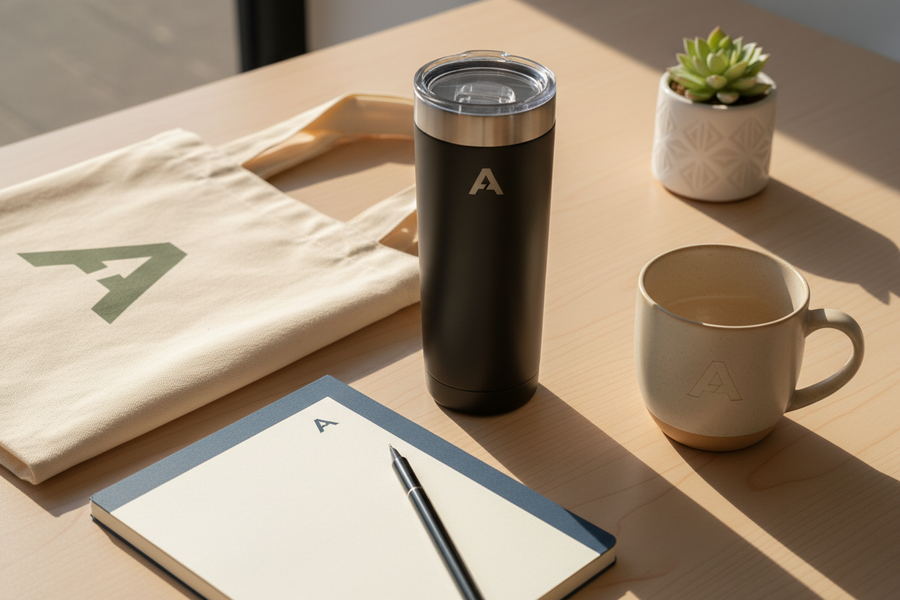
It’s fairly common to discover that choosing a slightly higher-quality version of a simple item yields five times the daily visibility of a lower-cost, overly complex gadget. A well-weighted ceramic mug or a dense cotton tote bag gets used weekly, whereas a cheap bluetooth novelty speaker often sits in a drawer after a single day.
--- ## Weeks 6–5: Balancing Tactile Quality and Unit Economics
Once you narrow down the product categories, the next step involves balancing budget constraints against material specifications. This is where unit economics meets physical reality. Buying teams often face a direct trade-off between quantity and individual item quality.
For example, if you have a fixed budget of $5,000, you can either source 1,000 budget-tier items at $5.00 each or 250 premium-tier items at $20.00 each. In almost every scenario focused on customer retention, opting for the lower quantity with higher tactile quality yields better long-term brand equity.
- Higher Retention: Premium materials (e.g., ring-spun cotton, heavy glass, solid stainless steel) feel valuable immediately upon touch.
- Subtle Aesthetic: Higher budget tiers support refined decoration methods like blind debossing or tonal stitching.
- Longer Product Lifespan: Durable construction means the item remains in active daily use for years rather than weeks.
- Higher Per-Unit Cost: Requires tighter recipient targeting or smaller batch distribution.
- Storage Considerations: Heavier items like fleece or ceramic add to total bulk transit weight.
Something that rarely gets discussed openly is how much fabric weight and material density dictate real-world wearability. A 140 GSM promotional t-shirt often feels thin and sheer after a single wash cycle, whereas a 200+ GSM combed cotton shirt holds its structure and earns a permanent spot in someone's weekly clothing rotation.
--- ## Weeks 4–3: Physical Sampling and the Reality of Decoration
Never skip the physical sample stage. Digital visual proofs are helpful for checking logo placement and spelling, but they tell you nothing about how a zipper glides, how a notebook opens, or how a tumbler feels in your hand.
What actually separates a 500-unit jacket order that recipients wear constantly from one that gets left behind usually comes down to decoration subtlety, not just the jacket brand. Overly large, bright screen prints across the chest turn apparel into a billboard that few people want to wear on the weekend. On the other hand, tonal embroidery on the sleeve or a quiet laser-etched mark on a custom tumbler creates a finished product that looks like retail gear.
During physical sample review, test the item under realistic conditions:
- Wash decorated fabric samples once or twice to verify colorfastness and print adhesion (checking against baseline expectations like ISO 105-C06 wash fastness).
- Check that liquid lids seal tightly on insulated drinkware.
- Test power bank charging speed and cable connectivity with standard mobile devices.
We once saw a team rush an order of 300 custom metal pens without requesting physical samples first. The digital proof looked flawless, but when the bulk shipment arrived, the ink cartridge sat slightly loose inside the barrel, causing a minor rattle when writing. The pens worked, but that tiny tactile flaw completely ruined the premium impression they were trying to create. Taking three days to hold a sample prevents those quiet disappointments every time.
--- ## Weeks 2–1: Finalizing Artwork, Proofs, and Batch Approvals
With samples approved, the project moves into pre-production approval. This stage is where timeline management becomes critical. Misunderstandings around artwork vector files or color matching codes can stall production quickly if not handled systematically.
When working through final pre-production sign-offs with your supplier, keep these operational details aligned:
- Verify artwork files are submitted as vector formats (.AI, .EPS, or vector .PDF) with all fonts outlined.
- Confirm exact Pantone (PMS) spot color references rather than relying on digital monitor RGB renders.
- Review exact print dimensions and placement offsets relative to garment seams or tumbler bases.
- Confirm bulk box packing specifications (e.g., individual polybagging vs. bulk layer packing).
- Re-verify final delivery address details, including loading dock availability or liftgate requirements.
It’s not unusual for suppliers to require 3 to 5 business days for final pre-production proof creation after artwork submission. Factor this buffer into your launch calendar so you aren't forced to pay rush freight charges to meet your target event date.
--- ## Week 0: Kitting, Distribution, and the Recipient Experience
The final stage of the merchandise journey is distribution. How an item arrives matters almost as much as the item itself. Unboxing a well-constructed custom hat or notebook from a clean, neatly folded presentation box feels like opening a thoughtful gift rather than unpacking promotional inventory.
If you are distributing gear directly to remote employees or remote clients, individual drop-shipping and custom kitting streamline the experience immensely. Having items pre-assembled into branded kits saves hours of manual labor for internal HR and marketing teams who would otherwise spend their weekend folding boxes and taping shipping labels.
By keeping your focus on high functional utility, subtle decoration, and disciplined timeline planning, your merchandise program will yield items that recipients genuinely appreciate—and use daily—for months and years to come.
--- ## What Buyers Usually Ask Next ### What is the single most reordered everyday merchandise item? Vacuum-insulated stainless steel tumblers (16 oz to 20 oz size) consistently rank as the highest-reordered merchandise category. Their combination of high daily desk utility, durable long-term construction, and excellent surface area for subtle laser-etching gives them one of the longest active lifespans of any custom product. ### How do we keep merchandise costs down without sacrificing item quality? The most effective way to optimize cost is by reducing total item count and focusing on core high-utility categories rather than ordering multiple inexpensive novelties. Additionally, ordering in standard wholesale tier breaks (e.g., 72, 144, or 288 units) significantly lowers per-unit decoration setup fees and freight costs. ### What is the safest sizing strategy for custom company apparel? When ordering unisex company apparel like hoodies or crewnecks without individual size collections in advance, follow a standard corporate distribution bell curve: 10% Small, 25% Medium, 35% Large, 20% XL, and 10% 2XL. Sizing slightly larger is always safer, as recipients generally prefer a comfortable, relaxed fit for everyday casual wear. ### Should we choose embroidery or screen printing for everyday items? It depends on the material substrate. For structured textiles like fleece hoodies, canvas bags, and headwear, embroidery (especially tonal or low-contrast thread) offers a rich, retail feel that survives repeated washing. For lightweight t-shirts or large smooth surfaces, soft-hand water-based screen printing provides a flexible, smooth finish that won't crack or feel heavy on the chest.